Electrophysiology CINRE, hospital BORY
Atrial Fibrillation: Guidelines (2026) Compendium / 11.3 Structural Heart Disease and the CAST Trial

Structural Heart Disease and the CAST Trial


The interest of arrhythmology in structural heart disease and Class IC antiarrhythmic drugs
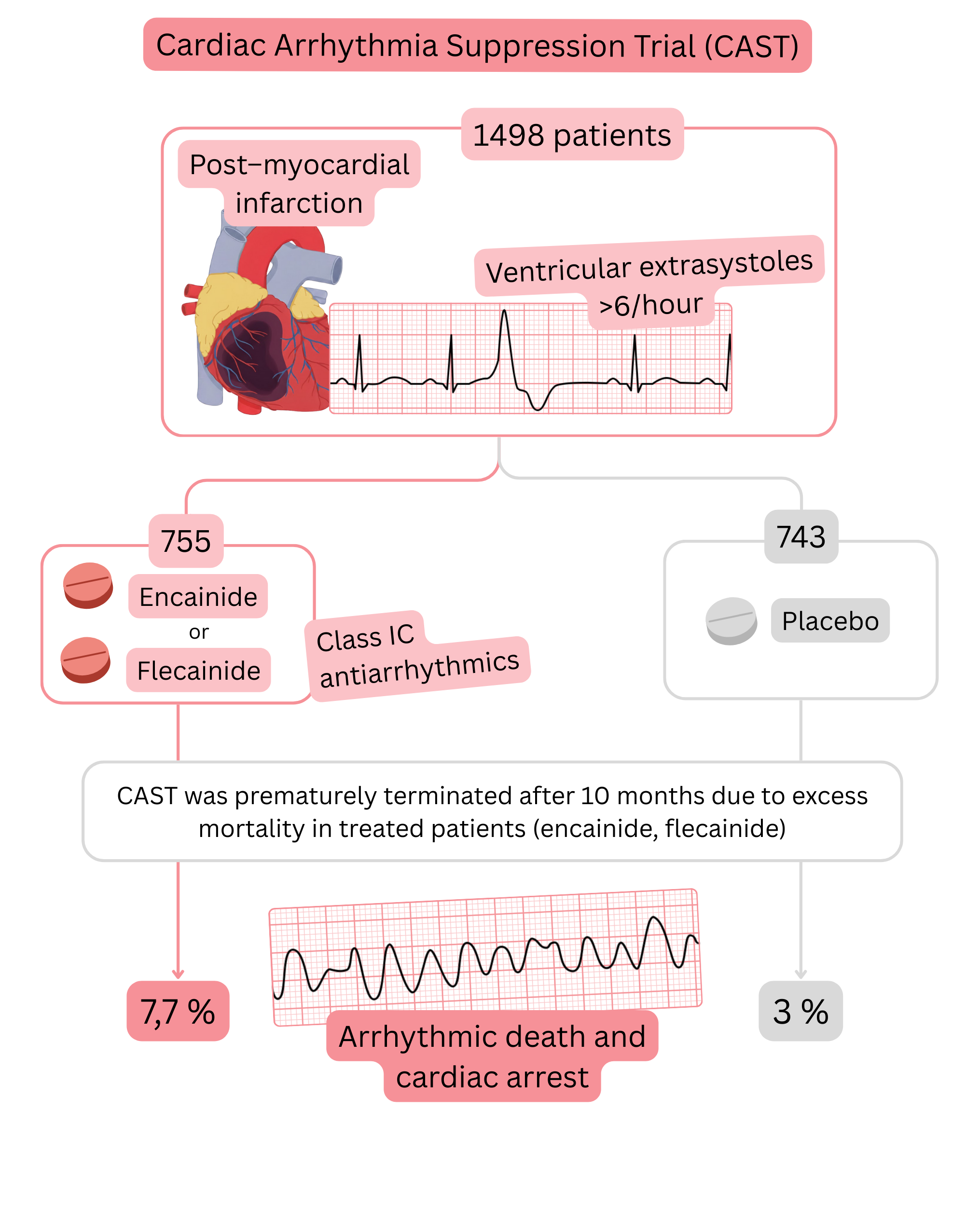
  • increased significantly after the Cardiac Arrhythmia Suppression Trial (CAST) in 1989.
Diagram of the CAST study illustrating increased mortality in post–myocardial infarction patients with ventricular premature beats treated with class IC antiarrhythmic drugs compared with placebo.

CAST trial

  • A total of 1498 patients were enrolled:
    • after myocardial infarction (6 days to 2 years after infarction),
    • patients had ventricular premature beats (VPBs) >6/hour or non-sustained ventricular tachycardia (VT).
  • Study objective: suppression of VPBs and non-sustained VT using Class IC antiarrhythmic drugs (encainide, flecainide).
  • The study had 2 arms:
    1. arm: patients received Class IC antiarrhythmic drugs (encainide, flecainide),
    2. arm: patients received placebo.
  • Patients were to be followed for 2 years,
    • follow-up was terminated prematurely after approximately 10 months due to sudden deaths and cardiac arrest.
  • Conclusion of the CAST trial:
    • suppression of VPBs >80% with Class IC antiarrhythmic drugs (encainide, flecainide),
    • the incidence of sudden cardiac death and cardiac arrest was:
      • 7.7% in the 1st arm (encainide, flecainide),
      • 3% in the 2nd arm (placebo).
    • The relative risk of death in post-infarction patients was 2.5× higher with Class IC antiarrhythmic drugs (encainide, flecainide).

Summary of the CAST trial:

  • The CAST trial was terminated prematurely after 10 months because patients treated with encainide or flecainide
    • had a higher mortality rate or cardiac arrest rate than patients receiving placebo (7.7% vs. 3%).
  • Class IC antiarrhythmic drugs (encainide, flecainide) are contraindicated in post-infarction patients,
    • because they increase the risk of sudden death and cardiac arrest 2.5-fold.

Mechanism of ventricular arrhythmia in the CAST trial
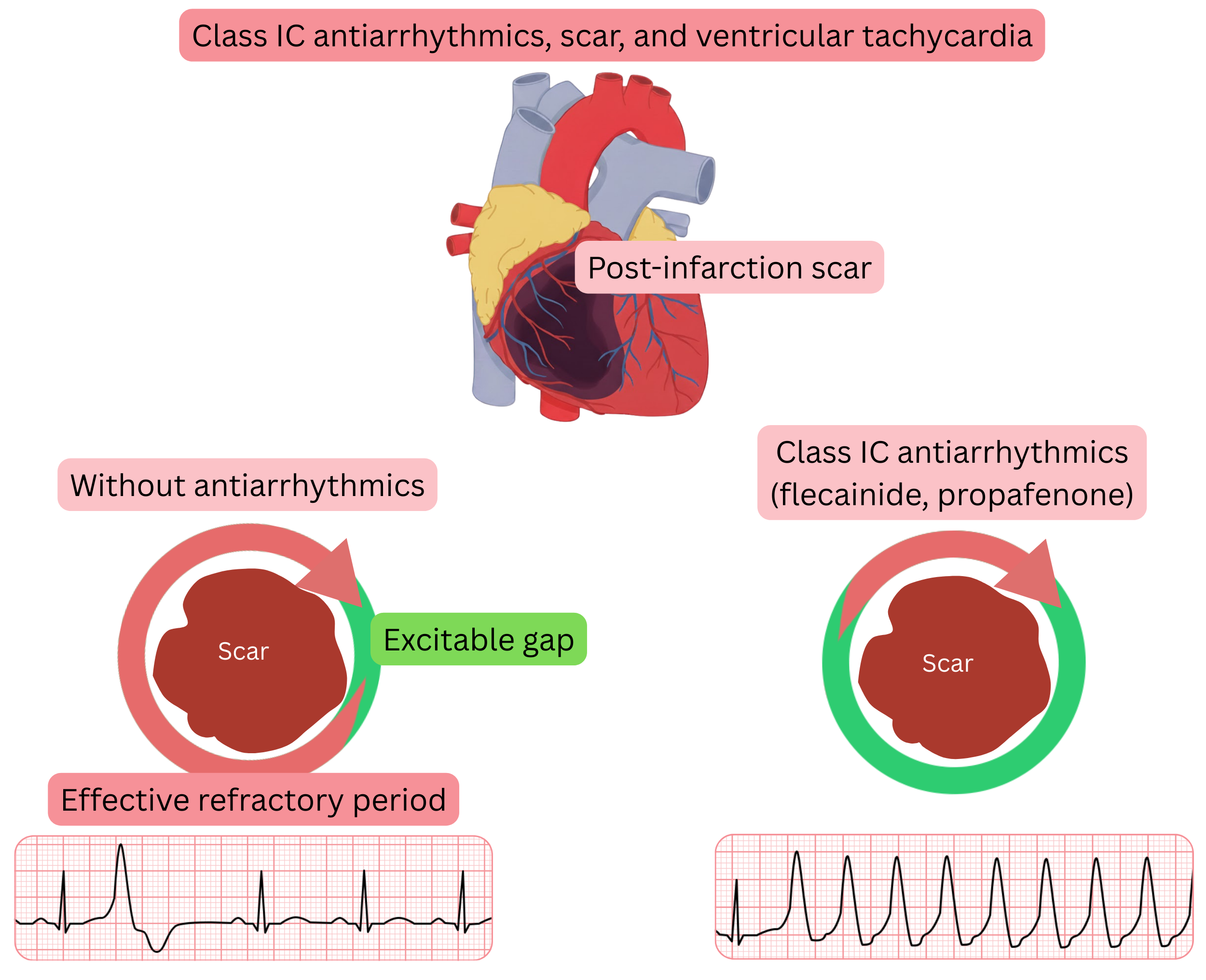
  • Class IC antiarrhythmic drugs (flecainide, encainide) slow impulse conduction.
    • The impulse (depolarization wave) then propagates more slowly and is shorter (not followed by a long refractory period).
    • The tissue becomes more easily re-excitable, facilitating a second depolarization wave or re-entry.
  • After myocardial infarction, a scar is present and the myocardium is electrically heterogeneous,
    • when Class IC antiarrhythmic drugs slow impulse propagation, re-entry can more easily develop around the scar,
    • leading to ventricular tachycardia and ventricular fibrillation.
Diagram illustrating the proarrhythmic mechanism of class IC antiarrhythmic drugs in post–myocardial infarction scar tissue, with formation of an excitable gap leading to ventricular tachycardia.

Extension of the CAST trial conclusions into clinical practice

  • The CAST trial evaluated Class IC antiarrhythmic drugs flecainide and encainide vs. placebo.
  • Based on the results, the conclusions of the CAST trial were extended to the entire Class IC,
    • including propafenone, although it was not directly evaluated in the CAST trial,
    • because all Class IC antiarrhythmic drugs predominantly block sodium channels.
  • The main mechanism of sudden death and cardiac arrest in the CAST trial was re-entry around a post-infarction scar.
    • Re-entry occurred due to the presence of a scar and impulse slowing caused by Class IC antiarrhythmic drugs.
    • Based on this, the conclusions of the CAST trial were extended to all cardiac diseases in which re-entry may occur,
      • i.e. scarred or electrically heterogeneous myocardium (e.g. cardiomyopathies),
      • that is, any structural heart disease.

Structural heart disease

  • In the context of arrhythmology, structural heart disease is understood
  • as any cardiac condition in which a substrate for re-entry may be present, i.e. if there is:
    • a scar,
    • electrically heterogeneous myocardium.
Structural heart disease
Previous myocardial infarction
Coronary artery disease
Ejection fraction (<40 %)
Left ventricular hypertrophy (>15 mm)
Cardiomyopathy (dilated, hypertrophic, restrictive, infiltrative)
Valvular disease – stenosis or regurgitation (moderate or severe)
Heart failure (NYHA II–IV, hospitalization for heart failure)
Status post cardiac surgery

In the following table, you can review the basic diagnostic methods and parameters used to diagnose structural heart disease.

Structural heart disease (diagnostics)
Diagnosis Diagnostics
Previous myocardial infarction ECG: pathological Q waves (≥ 40 ms, ≥ 25 % of QRS, ≥ 2 leads)
Echo: regional wall motion abnormality (akinesia, dyskinesia)
MRI: scar (LGE positive finding)
Coronary artery disease (IHD) CT coronary angiography: stenosis > 50 % left main, > 70 % other major branches
Exercise test: ST depression > 1 mm during stress = ischaemia
Ejection fraction (< 40 %) Echo: EF < 40 %
MRI: EF < 40 %
Left ventricular hypertrophy ECG: Sokolow–Lyon index > 35 mm
Echo: wall thickness > 15 mm
Cardiomyopathy Dilated: LVEDD > 55 mm + EF < 40 % (echo/MRI)
Hypertrophic: LV wall ≥ 15 mm (echo/MRI)
Restrictive: biatrial dilatation + diastolic dysfunction (E/e´ > 15)
Infiltrative: echo – speckled myocardium; MRI – diffuse LGE
Valvular disease (stenosis / regurgitation) Echo: stenosis or regurgitation (moderate or severe)
Heart failure (NYHA II–IV) Clinical: dyspnoea on exertion or at rest, oedema, orthopnoea, recurrent hospitalizations
Echo: EF < 40 % (HFrEF) or significant diastolic dysfunction (HFpEF / HFmrEF)
BNP > 35 pg/ml or NT-proBNP > 125 pg/ml
Status post cardiac surgery History: documented surgery (CABG, valve surgery, congenital defect)

In the following table, you can review the investigations and criteria that must be fulfilled for the safe administration of Class IC antiarrhythmic drugs in patients with atrial fibrillation (AF).

Criteria for administration of Class IC antiarrhythmic drugs in atrial fibrillation
Investigation Criteria
ECG No pathological Q waves (≥ 40 ms, ≥ 25 % of QRS, ≥ 2 leads)
No hypertrophy: Sokolow–Lyon index ≤ 35 mm (S in V1 + R in V5 or V6)
QRS < 120 ms (no bundle branch block)
QTc by sex: men < 450 ms, women < 470 ms
Echocardiography Ejection fraction (EF) ≥ 40 %
Wall thickness ≤ 15 mm
No dilatation: LVEDD < 55 mm, LA < 40 mm or < 34 ml/m²
Valves: at most mild regurgitation or stenosis
Exercise testing Negative for ischaemia
No induced arrhythmias
No drop in systolic blood pressure > 10 mmHg during exercise
CAG / CTA / MRI Indicated in case of clinical suspicion of IHD or cardiomyopathy
Significant coronary artery stenosis, post-infarction scar, or cardiomyopathy must be excluded

These guidelines are unofficial and do not represent formal guidelines issued by any professional cardiology society. They are intended for educational and informational purposes only.

Peter Blahut, MD

Peter Blahut, MD (Twitter(X), LinkedIn, PubMed)