Electrophysiology CINRE, hospital BORY

Sotalol


Classification:

  • Class III – Potassium (K⁺) channel blockers
    • Amiodarone – the most effective anti-arrhythmic drug, but associated with the highest rate of adverse effects.
    • Dronedarone – similar to amiodarone, but less potent and associated with fewer adverse effects.
    • Sotalol – also a non-selective beta-blocker.
    • Ibutilide – may be used for acute cardioversion of pre-excited atrial fibrillation (AF).
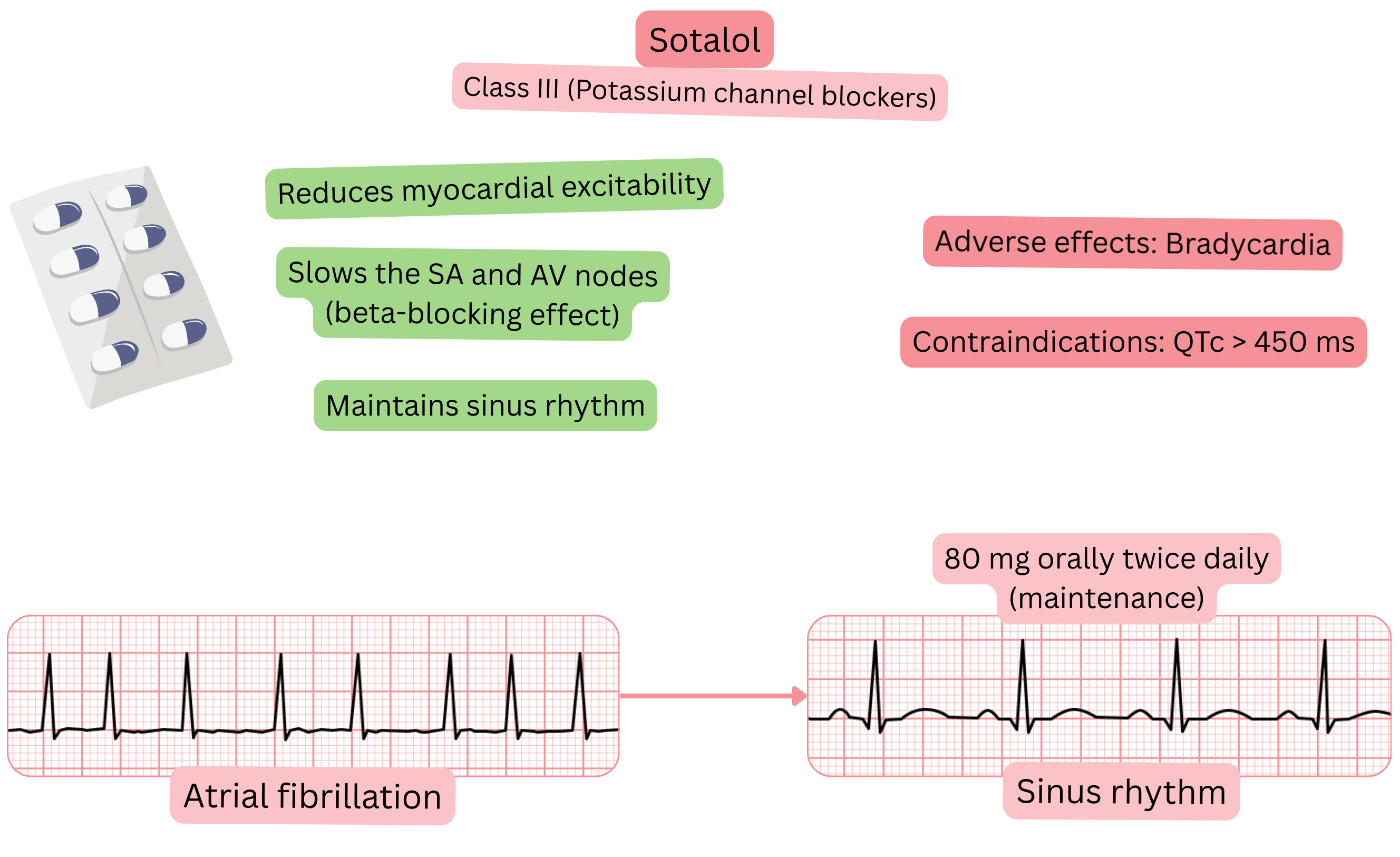
Diagram of the effect of sotalol as a class III antiarrhythmic illustrating potassium channel blockade with slowing of the SA and AV nodes, reduced myocardial excitability, and maintenance of sinus rhythm in atrial fibrillation.

Mechanism:

  • Prolongs the non-nodal action potential (AP) and effective refractory period (ERP) in the myocardium
    • Reduces excitability and automaticity and prevents re-entry
    • thereby reducing the risk of atrial fibrillation (AF) – maintains sinus rhythm.
  • Slows the SA node and AV node (as a beta-blocker)
  • Effect is dose-dependent
    • ≤ 160 mg/day → predominantly beta-blocker effect
    • 160–320 mg/day → additional Class III anti-arrhythmic effect (K⁺ channel blockade)
    • > 320 mg/day → markedly increased risk (2–4 %) of proarrhythmia (QT prolongation → torsades de pointes)
  • Reverse use-dependent (greater effect at lower heart rates), rate-dependent effect:
    • < 60/min – maximal effect → greatest QT prolongation
    • 60–100/min – moderate effect
    • > 100/min – reduced effect → minimal impact on QT

Effect on AF:

  • Maintenance of sinus rhythm – prevents recurrence of atrial fibrillation (AF)
Sotalol and atrial fibrillation (AF)
Brand names
Sotalol, Sotalex, Sotacor
Indications
  • Maintenance of sinus rhythm
Dosing
  • Chronic rhythm control – maintenance of sinus rhythm (oral)
    • 80–160 mg twice daily
      • Increase the dose every 3 days if QTc < 500 ms
      • 80 mg twice daily → 120 mg twice daily → 160 mg twice daily
Onset of action
  • 1–2 hours (oral)
Effect
Maintenance of sinus rhythm (paroxysmal or persistent AF) at 1 year
  • 40–55 % (oral)
Duration of action
  • 12–24 hours (oral)
Contraindications
  • Prolonged QTc interval > 450 ms
  • Long QT syndrome
  • Second- or third-degree AV block
  • Bronchial asthma or other bronchospastic disorders
  • Sinus bradycardia (< 50/min)
  • Cardiogenic shock
  • Decompensated heart failure
  • Electrolyte imbalance (potassium, sodium, magnesium)
  • Sick sinus syndrome (without pacemaker)
  • Concomitant use of myocardial depressant anaesthetics
  • Allergy to sotalol

Patient monitoring after initiation of sotalol:

  • Discontinue if contraindications occur
  • Discontinue or reduce the dose if adverse effects occur
Patient monitoring after initiation of sotalol
Time from initiation What to monitor Reason for treatment discontinuation
1–3 days
(from initiation or
after dose increase)
ECG (QTc)
Blood pressure
QTc > 500 ms
Bradycardia < 50/min
Hypotension < 90/60 mmHg
7 days – 1 month ECG (QTc)
Blood pressure
Laboratory tests (electrolytes, renal function)
QTc > 500 ms
Bradycardia < 50/min
Hypotension < 90/60 mmHg
Severe electrolyte imbalance (Na⁺, K⁺, Mg²⁺)
6–12 months ECG (QTc)
Echocardiography
Laboratory tests (electrolytes, renal function)
QTc > 500 ms
Severe electrolyte imbalance (Na⁺, K⁺, Mg²⁺)

Adverse effects:

  • Very common (> 10 %):
    • Bradycardia
    • Chest pain
    • Headache
    • Palpitations
    • Dizziness
    • Fatigue
    • Weakness
    • Dyspnoea
  • Common (1–10 %):
    • Second- or third-degree AV block
    • Torsades de pointes (may occur already at QTc > 450 ms)
    • Sweating
    • Abdominal pain
    • Diarrhoea
    • Nausea and vomiting
    • Musculoskeletal pain
    • Visual disturbances
  • Less common (< 1 %):
    • SA node dysfunction
    • Peripheral neuropathy
Sotalol vs. beta-blockers in atrial fibrillation (AF)
Property Sotalol Beta-blockers
Class Class III + non-selective beta-blocker Class II (pure beta-blockers)
Mechanism K⁺ channel blockade + β-receptor blockade β₁ blockade (reduction of heart rate and AV conduction)
Effect on QT interval Prolongs QT (risk of TdP) No effect on QT
Reverse use-dependence Strong effect at HR < 60/min
Weak effect at HR > 100/min
No
Dose dependence < 160 mg/day → beta-blocker effect
≥ 160–320 mg/day → beta-blocker + Class III effect
Dose determines strength of beta-blocker effect, without Class III activity
Indication in AF Maintenance of sinus rhythm (rhythm control) Heart rate control
Adverse effects Torsades de pointes (at QTc ≥ 500 ms) Bronchospasm, fatigue, bradycardia, hypotension


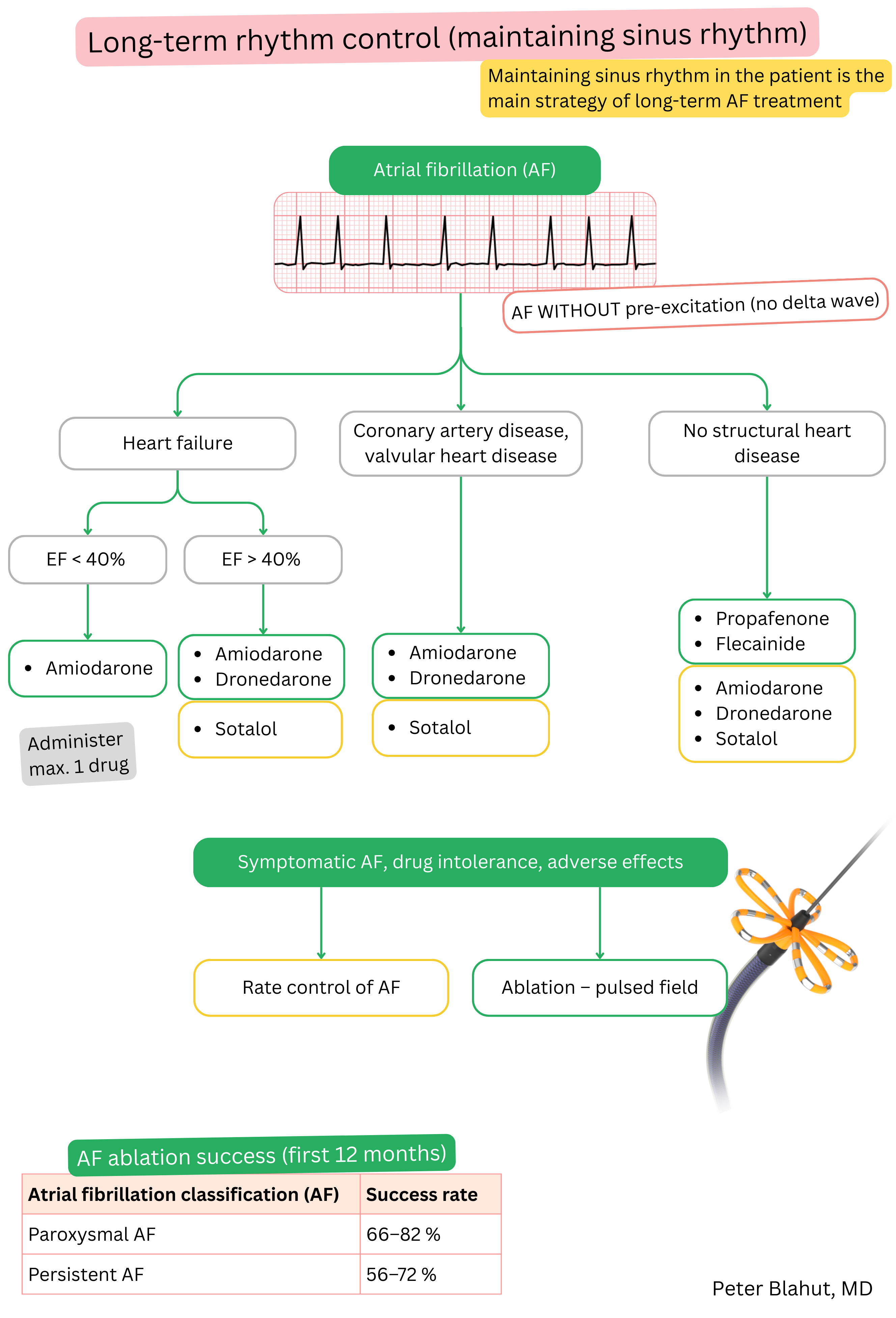
Guideline algorithm for long-term rhythm control in atrial fibrillation with antiarrhythmic selection based on structural heart disease and left ventricular function including catheter ablation indication.

These guidelines are unofficial and do not represent formal guidelines issued by any professional cardiology society. They are intended for educational and informational purposes only.

Peter Blahut, MD

Peter Blahut, MD (Twitter(X), LinkedIn, PubMed)