Electrophysiology CINRE, hospital BORY

Procainamide


Classification:

  • Class IA – Sodium (Na⁺) channel blockers
    • Procainamide – mainly used in patients with pre-excited atrial fibrillation (AF).
    • Disopyramide – due to its vagolytic effect, suitable in vagal AF.
Diagram of the effect of procainamide as a class IA antiarrhythmic illustrating reduced myocardial excitability, prolongation of the effective refractory period of an accessory pathway, and pharmacological cardioversion of preexcited atrial fibrillation to sinus rhythm.

Mechanism:

  • Slows conduction velocity and reduces excitability in atrial and ventricular myocardium
    • Blocks sodium channels
  • Prolongs the effective refractory period (ERP) in atrial and ventricular myocardium
    • Its metabolite (NAPA) blocks potassium channels (therefore it also exhibits Class III properties)
  • Accessory pathway – prolongs ERP and slows conduction
  • Use-dependent (effect increases at heart rate > 90/min.)

Effect on AF:

  • Cardioversion of pre-excited atrial fibrillation (AF) to sinus rhythm – restoration of sinus rhythm
Procainamide and atrial fibrillation (AF)
Brand names
Procainamid, Pronestyl, Procan, Procanbid, Novocainamid, Novocamid
Indications
  • Acute cardioversion of pre-excited AF to sinus rhythm
Dosing
  • Acute cardioversion of pre-excited AF (intravenous)
    • 20–50 mg/min administered up to a maximum total dose of 17 mg/kg
    • Administer until conversion to sinus rhythm or until a total dose of 1.5 g is reached
  • Maintenance infusion (intravenous)
    • 1–4 mg/min for a maximum of 12 hours
Onset of action
  • < 30 minutes
Effect
Time to conversion to sinus rhythm and success rate
  • < 30 minutes – success rate 50–75 % (intravenous)
Duration of action
  • 2–4 hours (intravenous)
Contraindications
  • Second- or third-degree AV block (without pacemaker)
  • Prolonged QTc interval ≥ 500 ms
  • Systemic lupus erythematosus
  • History of torsades de pointes
  • Myasthenia gravis
  • Severe heart failure
  • Allergy to procainamide

Patient monitoring during procainamide administration:

  • Stop administration if a reason for infusion discontinuation occurs (see table below).
Patient monitoring during procainamide administration
Monitoring period What to monitor Reason for discontinuation
During infusion ECG (QRS, QTc interval, rhythm)
Blood pressure
Clinical status (dizziness, weakness)
QRS widening > 25%
QTc > 500 ms
Bradycardia < 40/min
Hypotension < 90/60 mmHg
Ventricular arrhythmia
30–120 minutes after administration ECG (QRS, QTc interval, rhythm)
Blood pressure
Clinical status (dizziness, weakness)
QRS widening > 25%
QTc > 500 ms
Bradycardia < 40/min
Hypotension < 90/60 mmHg
Ventricular arrhythmia

Adverse effects:

  • Very common (>10%):
    • Drug-induced lupus erythematosus – up to 20–30 % (with long-term oral use)
  • Common (1–10%)
    • Hypotension
    • Bradycardia
    • QRS widening
    • QT interval prolongation
    • AV block
    • Ventricular arrhythmias (mainly extrasystoles)
    • Haematological disorders, e.g. agranulocytosis (with long-term oral use)
  • Less common (< 1%)
    • Flushing, dizziness – due to transient hypotension
    • Nausea or gastrointestinal discomfort

For pharmacological cardioversion of pre-excited AF, both procainamide and ibutilide may be used.

  • Procainamide is preferred, but ibutilide is also a suitable alternative.
Procainamide vs Ibutilide and atrial fibrillation
Property Procainamide Ibutilide
Class IA (Na⁺ channel blocker, minimal K⁺ blockade) III (K⁺ channel blocker)
Cardioversion of pre-excited AF Yes – first-line drug Yes – possible, but less preferred
Indication in AF Acute cardioversion of pre-excited AF Acute cardioversion of AF or atrial flutter
Conversion success rate to SR 50–75 % (within 30 minutes) ~30–50 % in AF, 60–75 % in atrial flutter
Use in atrial flutter No Yes
Main risks Hypotension, proarrhythmia (torsades de pointes), lupus-like syndrome QT prolongation, torsades de pointes
Typical patient Younger patient with AF and WPW (delta wave on ECG) Patient with AF or atrial flutter without WPW, for urgent conversion


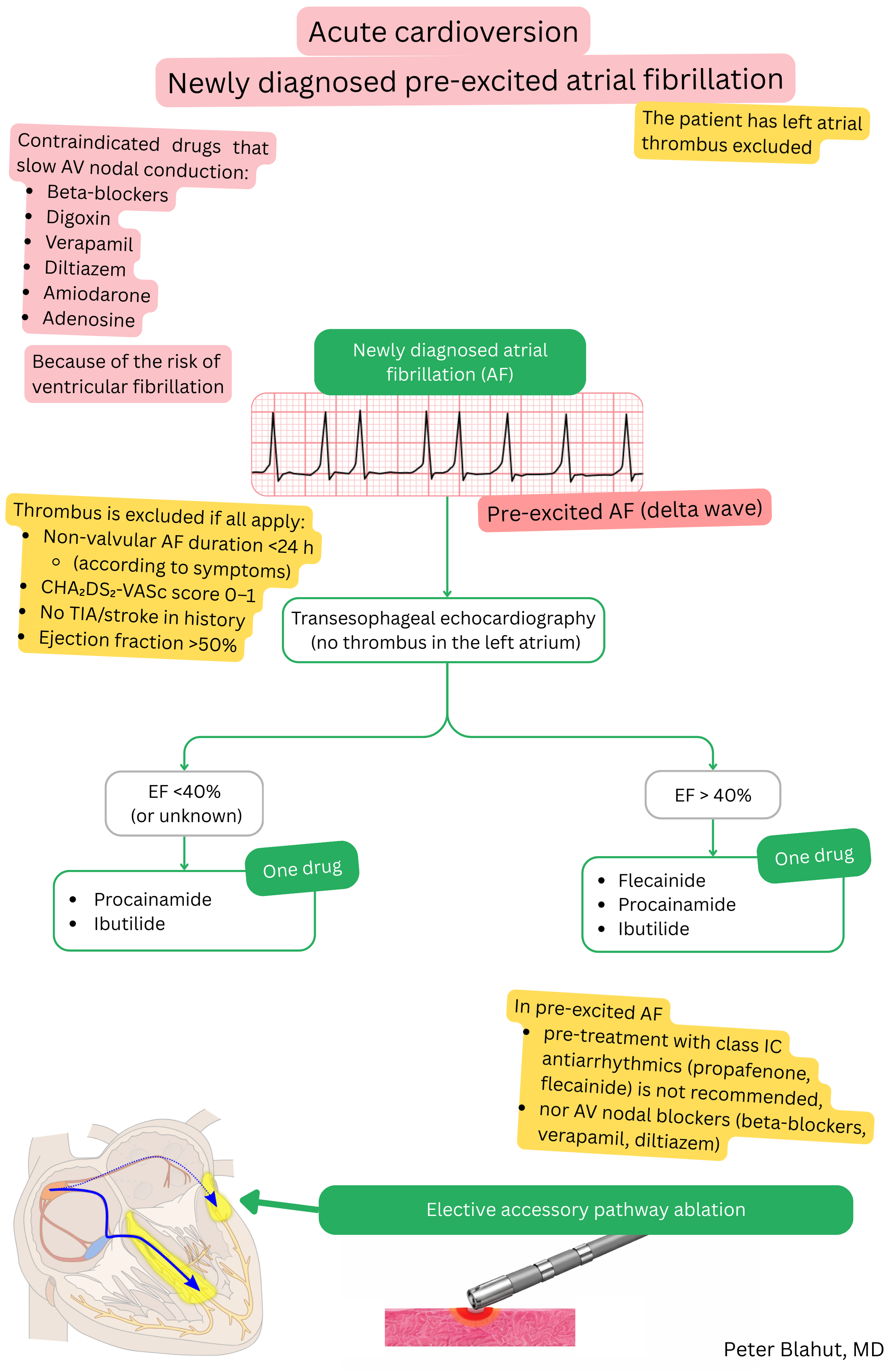
Guideline algorithm for acute cardioversion in newly diagnosed pre-excited atrial fibrillation with contraindication to AV nodal blockers and antiarrhythmic selection based on ejection fraction.

These guidelines are unofficial and do not represent formal guidelines issued by any professional cardiology society. They are intended for educational and informational purposes only.

Peter Blahut, MD

Peter Blahut, MD (Twitter(X), LinkedIn, PubMed)