
Peripheral arterial disease (PAD) is a broader term that includes atherosclerotic involvement of arteries other than the coronary arteries and the aorta. In PAD, stenosis (narrowing) and eventually occlusion (closure) of peripheral arteries develop progressively. The main risk factors for PAD are similar to those for atrial fibrillation (AF):
| Peripheral arterial disease (PAD) – involvement of peripheral arteries | |
|---|---|
| Peripheral arteries | Prevalence in PAD (%) |
| Lower extremity arteries | 40 – 50 % |
| Carotid arteries | 20 – 30 % |
| Upper extremity arteries | 5 – 10 % |
| Renal arteries | 5 – 10 % |
| Mesenteric artery | 1 – 2 % |
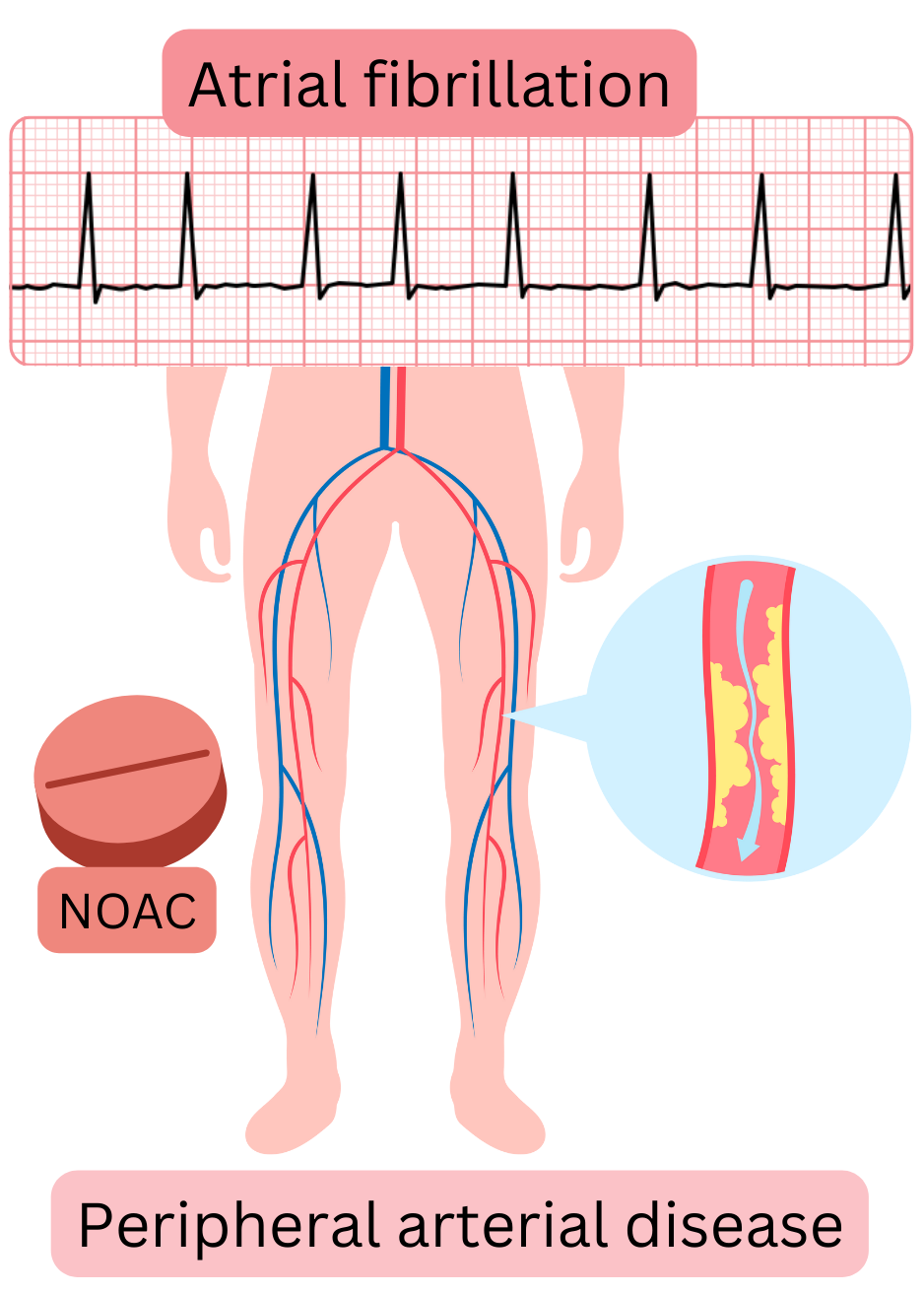
The prevalence of PAD in the population is 1–5% (>15% in older patients >80 years).
The term PAD is often used to refer to lower extremity PAD (LE-PAD), because LE-PAD is the most common form of PAD. In patients with AF, the most available data therefore relate to the combination of AF and LE-PAD.
LE-PAD is present in 6–14% of patients with AF.
The most common symptoms of LE-PAD:
High-risk LE-PAD is defined as:
Asymptomatic LE-PAD does not require antiplatelet or anticoagulation therapy.
If a patient has PAD and AF requiring anticoagulation therapy, anticoagulation therapy alone is given (without antiplatelet therapy).
A patient with AF (with an indication for anticoagulation therapy), after revascularization for PAD
| Peripheral arterial disease and atrial fibrillation | Class |
|---|---|
| In PAD and AF (requiring anticoagulation therapy), anticoagulation therapy alone (preferably NOAC) is recommended, without antiplatelet therapy. | I |
PAD - Peripheral arterial disease NOAC – Non-vitamin K oral anticoagulants (Dabigatran, Rivaroxaban, Apixaban, Edoxaban)
These guidelines are unofficial and do not represent formal guidelines issued by any professional cardiology society. They are intended for educational and informational purposes only.