Electrophysiology CINRE, hospital BORY

Dronedarone


Classification:

  • Class III – Potassium (K⁺) channel blockers
    • Amiodarone – the most effective anti-arrhythmic drug, but associated with the highest rate of adverse effects.
    • Dronedarone – similar to amiodarone, but less potent and associated with fewer adverse effects.
    • Sotalol – also a non-selective beta-blocker.
    • Ibutilide – may be used for acute cardioversion of pre-excited atrial fibrillation (AF).
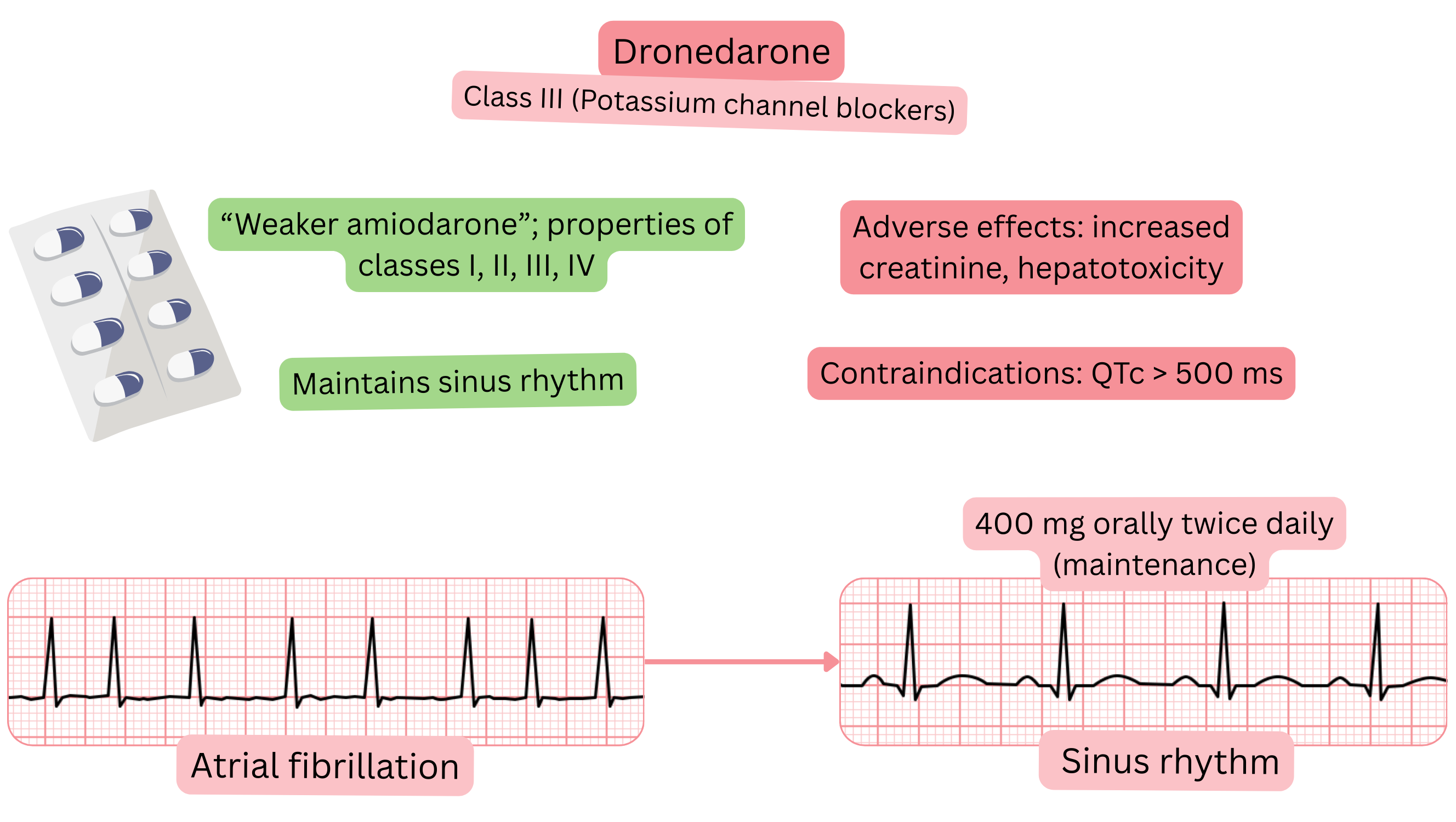
Diagram of the effect of dronedarone as a class III antiarrhythmic illustrating multichannel action, maintenance of sinus rhythm, and pharmacological treatment of atrial fibrillation.

Mechanism:

  • Dronedarone is a “modified amiodarone”; it is less potent and associated with fewer adverse effects than amiodarone.
  • Predominantly exhibits Class III properties, but also Class I, II, and IV effects
    • Prolongs the effective refractory period (ERP) in atrial and ventricular myocardium
  • Reduces excitability and automaticity and prevents re-entry
  • Slows the SA node and prolongs conduction through the AV node
  • Slows conduction in the conduction system and working myocardium
  • Has a vasodilatory effect on vascular smooth muscle
  • Minimal (almost no) reverse use-dependence

Effect on AF:

  • Maintenance of sinus rhythm – prevents recurrence of atrial fibrillation (AF)
Dronedarone and atrial fibrillation (AF)
Brand name
Multaq
Indications
  • Maintenance of sinus rhythm
Dosing
  • Chronic rhythm control – maintenance of sinus rhythm (oral)
    • 400 mg twice daily
Onset of action
  • 3–6 hours (oral)
Effect
Maintenance of sinus rhythm (paroxysmal or persistent AF) at 1 year
  • 30–40 %
Duration of action
  • 12–24 hours (oral)
Contraindications
  • Permanent atrial fibrillation (when sinus rhythm cannot be restored)
  • QTc interval ≥ 500 ms
  • PR interval > 280 ms
  • Current or previous cardiac decompensation
  • Chronic heart failure (NYHA III, IV)
  • HFrEF < 40 %
  • Second- or third-degree AV block (without pacemaker)
  • Sick sinus syndrome (without pacemaker)
  • Bradycardia < 50/min
  • Pulmonary toxicity after amiodarone
  • Hepatotoxicity after amiodarone
  • Severe hepatic impairment
  • Allergy to dronedarone
  • Concomitant use of erythromycin
  • Concomitant use of strong CYP3A4 inhibitors
    • e.g. ketoconazole, itraconazole, voriconazole, ciclosporin, clarithromycin, ritonavir
  • Concomitant use of QT-prolonging drugs
    • e.g. tricyclic antidepressants, macrolides, Class I and III anti-arrhythmic drugs

Patient monitoring after initiation of dronedarone:

  • Discontinue or reduce the dose if adverse effects occur
Patient monitoring before and during dronedarone therapy
Time What to monitor Reason for discontinuation
Before initiation ECG (QTc interval, AV block)
Liver tests (ALT, AST, GGT, ALP, bilirubin)
QTc ≥ 500 ms
Second- or third-degree AV block
Abnormal liver tests
2 months Liver tests
ECG
Marked deterioration of liver tests
QTc interval ≥ 500 ms
PR interval > 280 ms
4 months Liver tests
ECG
Marked deterioration of liver tests
QTc interval ≥ 500 ms
PR interval > 280 ms
6 months Liver tests
ECG
Marked deterioration of liver tests
QTc interval ≥ 500 ms
PR interval > 280 ms
Every 1 year Liver tests
ECG
Echocardiography
Marked deterioration of liver tests
QTc interval ≥ 500 ms
PR interval > 280 ms
Ejection fraction < 40%

Adverse effects:

  • Very common (> 10 %):
    • Increase in serum creatinine (51 %)
    • QT interval prolongation (28 %)
  • Common (1–10 %):
    • Hepatotoxicity
    • Bradycardia
    • Skin reactions
    • Abdominal pain
    • Diarrhoea
    • Dyspepsia
    • Nausea
    • Vomiting
    • Weakness
  • Less common (< 1 %):
    • Torsades de pointes
    • Photosensitivity
    • Taste disturbance

Amiodarone and dronedarone both belong to Class III anti-arrhythmic drugs but differ in their properties.

  • Amiodarone is more effective for maintenance of sinus rhythm,
  • whereas dronedarone is less potent but associated with fewer adverse effects.
Amiodarone vs dronedarone and atrial fibrillation
Property Amiodarone Dronedarone
Efficacy (maintenance of SR) 60–70 % at 1 year 30–40 % at 1 year
Onset of action Slow (days–weeks, full effect after loading of ~10 g) Faster (3–6 hours)
Duration of action Persists 2–3 months after discontinuation 12–24 hours (disappears after dose omission)
Suitable patient Also with structural heart disease Patient without structural heart disease and with preserved ejection fraction
Heart failure May be used (including HFrEF) Contraindicated (NYHA III–IV, HFrEF < 40 %)
Tissue accumulation Yes – adipose tissue, lungs, eye, thyroid gland Minimal
Lungs (toxicity) Pulmonary fibrosis, interstitial pneumonitis No pulmonary toxicity
Liver (toxicity) Mild hepatotoxicity, elevated liver enzymes Possible severe hepatitis, hepatic failure
Thyroid (toxicity) Hypothyroidism and hyperthyroidism No effect on the thyroid gland
Eyes (toxicity) Corneal deposits, optic neuropathy No ocular toxicity
Skin (toxicity) Photosensitivity, blue-grey skin discoloration Skin rash, pruritus


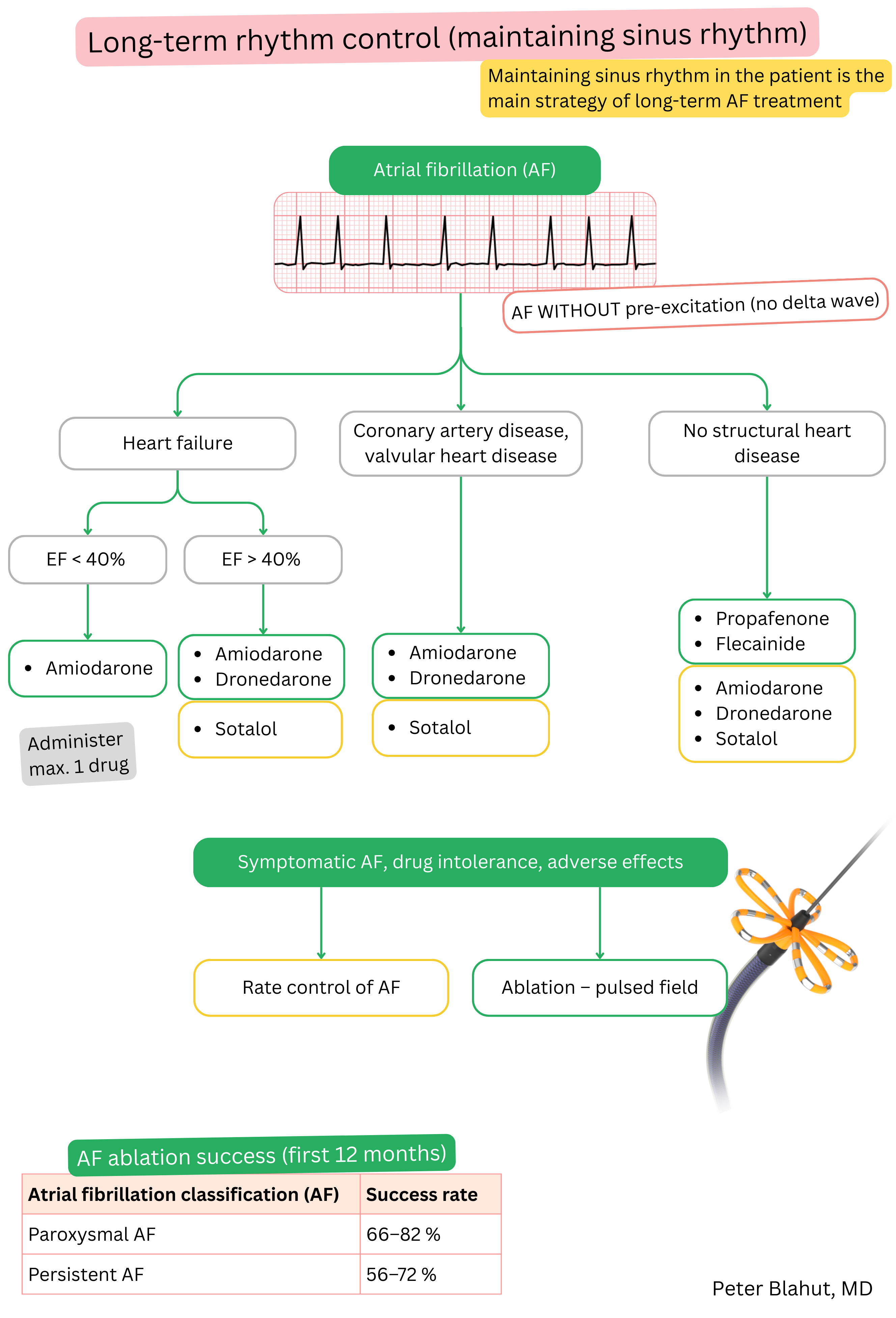
Guideline algorithm for long-term rhythm control in atrial fibrillation with antiarrhythmic selection based on structural heart disease and left ventricular function including catheter ablation indication.

These guidelines are unofficial and do not represent formal guidelines issued by any professional cardiology society. They are intended for educational and informational purposes only.

Peter Blahut, MD

Peter Blahut, MD (Twitter(X), LinkedIn, PubMed)