
Atrial fibrillation (AF) is diagnosed using any device that records the electrical activity of the heart on the principle of a voltmeter and displays this electrical activity as an ECG tracing:
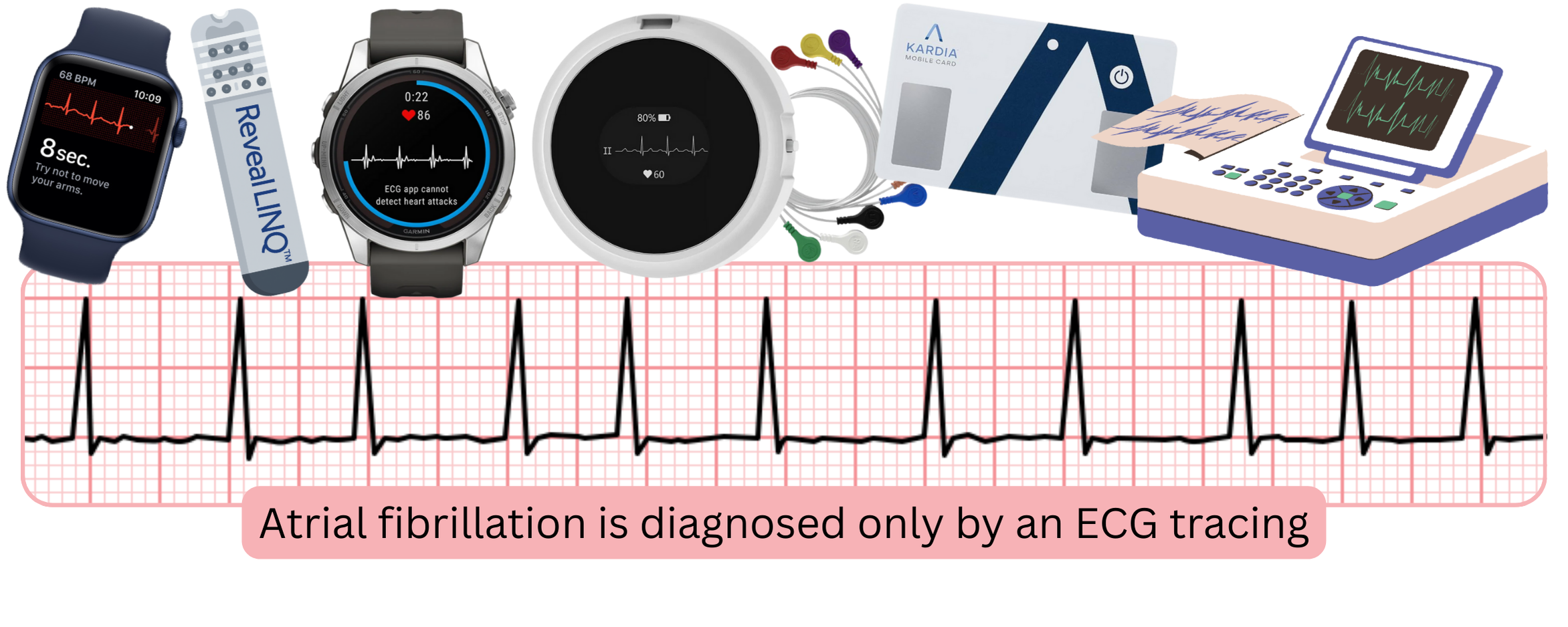
Smart devices with ECG record the electrical activity of the heart and generate a single-lead ECG; for example, a watch produces an ECG lead that corresponds precisely to lead I on a standard 12-lead ECG.
Using an ECG watch, it is technically possible to sequentially record a 12-lead ECG; however, the leads are not recorded simultaneously but sequentially. The ECG watch is successively placed on the chest, arms, and lower limb. In clinical practice, this is not routinely used, but it is technically feasible. If the ECG watch is placed on the chest at the position corresponding to lead V1, it is possible, for example, to diagnose a Brugada ECG pattern.
ECG tracing:
For the diagnosis of AF, capturing AF on ECG is crucial; AF does not need to last 30 seconds, for example:
| Diagnosis of Atrial Fibrillation | Class |
|---|---|
|
Atrial fibrillation is diagnosed primarily using ECG:
|
I |
| The diagnosis of atrial fibrillation based on ECG must be confirmed by a physician in the outpatient setting or online via a reliable platform, for example www.ECGsmart.com | I |
AF is not diagnosed using devices that do not record the electrical activity of the heart, such as: a conventional blood pressure monitor, an oximeter, or smart devices that measure pulse based on photoplethysmography.
These guidelines are unofficial and do not represent formal guidelines issued by any professional cardiology society. They are intended for educational and informational purposes only.