| Classification of Atrial Fibrillation According to Episodes and Valvular Disease |
| Newly diagnosed AF |
- Refers to the date when AF was first documented on ECG, regardless of how long the patient has had symptoms.
- 10 % of patients are asymptomatic during AF episodes.
- For example: the patient has had AF episodes for 2 years and does not perceive them.
|
| Paroxysmal AF |
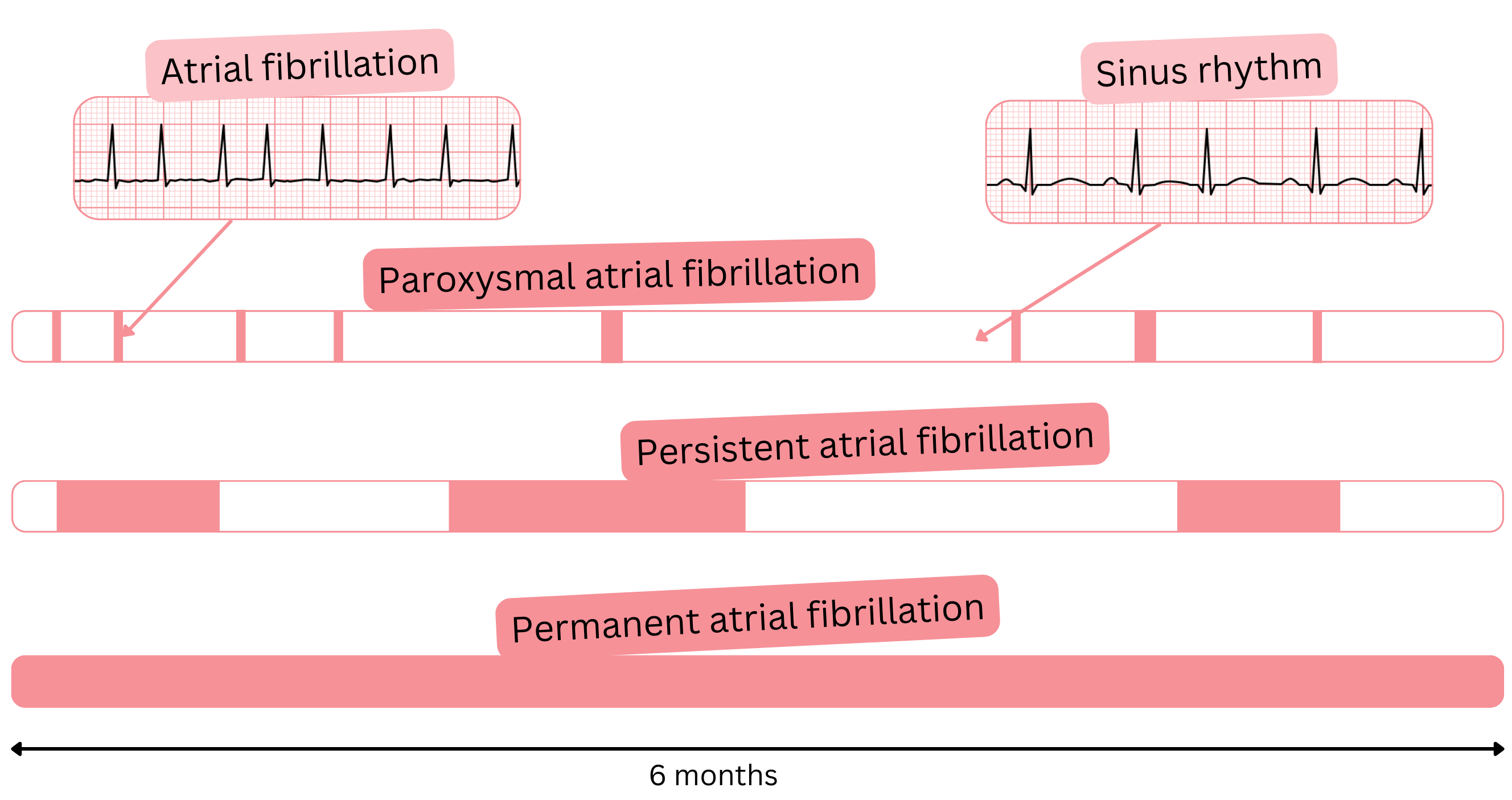
- An AF episode lasts less than 7 days.
- Episodes usually terminate within 48 hours.
- The AF episode terminates spontaneously or with intervention:
- pharmacological or electrical cardioversion.
- The treatment strategy is rhythm control (maintain sinus rhythm):
- pharmacological therapy, electrical cardioversion, or ablation.
|
| Persistent AF |
- An AF episode lasts more than 7 days.
- The episode usually does not terminate spontaneously, and intervention is required for termination:
- pharmacological or electrical cardioversion.
- The treatment strategy is rhythm control (maintain sinus rhythm):
- pharmacological therapy, electrical cardioversion, or ablation.
|
| Long-standing persistent AF |
- An AF episode lasts more than 12 months.
- The treatment strategy remains rhythm control (maintain sinus rhythm):
- pharmacological therapy, electrical cardioversion, or ablation.
|
| Permanent AF |
- The AF episode lasts at least 6 months.
- Repeated attempts to restore sinus rhythm have failed.
- The physician, in agreement with the patient, no longer attempts to restore sinus rhythm.
- The principle applies that every patient should have at least one attempt to restore sinus rhythm:
- pharmacological or electrical cardioversion or ablation.
- The treatment strategy is rate control (maintain AF ventricular rate <100/min):
|
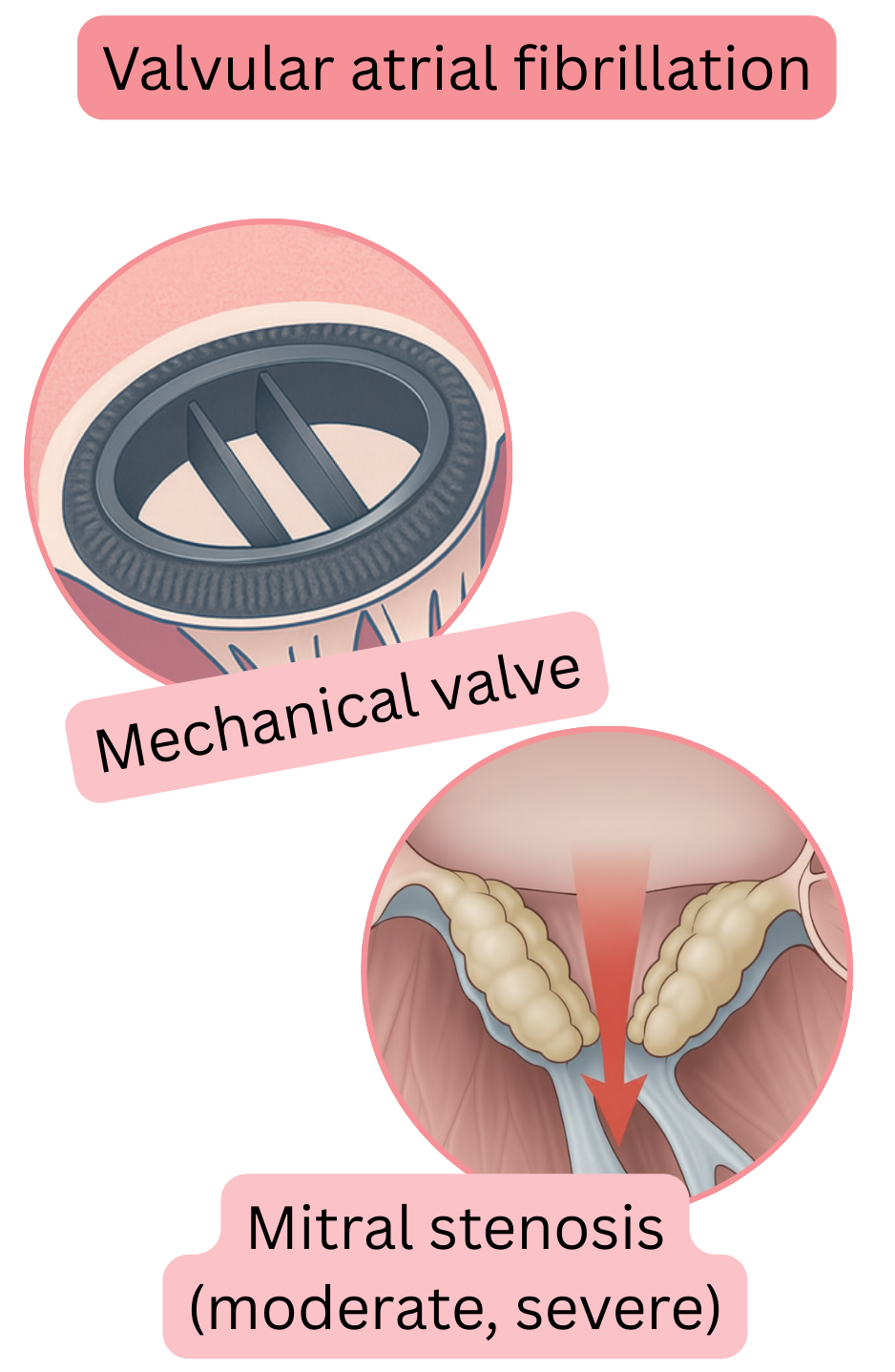
| Valvular AF |
- Refers to any AF in a patient who has:
- a mechanical valve or
- mitral stenosis (moderate or severe)
- Regardless of the CHA2DS2-VA score, these patients must always receive warfarin, not a NOAC.
|
NOAC – Non-vitamin K Oral Anticoagulant (Dabigatran, Rivaroxaban, Apixaban, Edoxaban)
In clinical practice, AF is most commonly classified as newly diagnosed (date when AF was first documented on ECG), paroxysmal, persistent, permanent, and valvular. Documentation in the patient record may appear, for example, as follows:
- Paroxysmal AF (diagnosed 2 April 2022)
- Persistent AF (diagnosed 4 April 2020)
| Classification of Atrial Fibrillation |
Class |
|
Atrial fibrillation is classified according to episodes and valvular disease into:
- Newly diagnosed AF (date of first documented AF on ECG)
- Paroxysmal AF
- Persistent AF
- Permanent AF
- Valvular AF
- (mechanical valve or mitral stenosis – moderate or severe)
|
I |
AF causes atrial remodelling; therefore, AF gradually progresses:
- paroxysmal → persistent → permanent; this process takes years.
The progression of AF can be slowed if the patient initiates adequate pharmacological therapy and risk factor modification.
With adequate treatment (pharmacological therapy, electrical cardioversion, ablation) and risk factor modification, improvement of AF may occur: persistent → paroxysmal AF → sinus rhythm.
Despite comprehensive treatment, complete elimination of AF is sometimes not achieved.
| Atrial Fibrillation – Prevalence by Episode Type |
| AF Type |
% of cases |
| Paroxysmal |
50 % |
| Persistent |
30 % |
| Permanent |
20 % |
Paroxysmal AF is the most common form of AF – it accounts for approximately 50 % of all cases.
- Paroxysmal AF means that episodes last less than 7 days (most commonly resolve within 24 hours).
- This definition is very broad – paroxysmal AF may present with episodes of varying duration and frequency.
- Examples of paroxysmal AF:
- Short episodes lasting only a few minutes, occurring once every few months.
- Longer episodes lasting several hours, which may recur several times per day.