Electrophysiology CINRE, hospital BORY
Atrial Fibrillation: Guidelines (2026) Compendium / 4.2 SPERRI and Atrial Fibrillation

SPERRI and Atrial Fibrillation


An accessory pathway is present in 0.1–0.3 % of the population.

An accessory pathway (anterograde) produces pre-excitation. Pre-excitation means that part of the ventricles is activated (excited) earlier than via the conduction system (AV node -> His -> bundle branches). Pre-excitation produces a delta wave on ECG.

  • An anterograde pathway conducts from atrium to ventricle—producing a delta wave.
  • A retrograde pathway conducts from ventricle to atrium—does not produce a delta wave.

WPW syndrome (symptomatic pre-excitation)

  • The patient has a delta wave on ECG and is symptomatic or has documented arrhythmia:
    • They have palpitations, syncope, dizziness, AVRT (AV re-entry tachycardia), or atrial fibrillation (AF).
  • The risk of sudden cardiac death is <0.5 %.

WPW pattern (asymptomatic pre-excitation)

  • The patient has a delta wave on ECG but is asymptomatic and has no documented arrhythmia:
    • No palpitations, syncope, dizziness, AVRT, or AF.
  • The risk of sudden cardiac death is 0.1 %.

Malignant accessory pathway

  • Is a pathway that can rapidly (≥240/min) conduct atrial impulses during AF to the ventricles.
  • May cause ventricular fibrillation and sudden cardiac death.
  • A malignant accessory pathway is defined by the SPERRI parameter, which can be assessed during an AF episode.
  • SPERRI ≤250 ms (≤6.25 small squares on a standard ECG at a paper speed of 25 mm/s)

SPERRI (Shortest Preexcited RR Interval)
  • Is the shortest RR interval that still has a delta wave.
    • All shorter RR intervals no longer have a delta wave because the pathway can no longer conduct at such a high rate.
  • SPERRI is best assessed during tachy-AF because RR intervals vary in length, i.e., in rate.
  • A malignant accessory pathway has SPERRI ≤250 ms (≤6.25 small squares on a standard ECG at a paper speed of 25 mm/s)
    • which corresponds to a rate of ≥240/min.
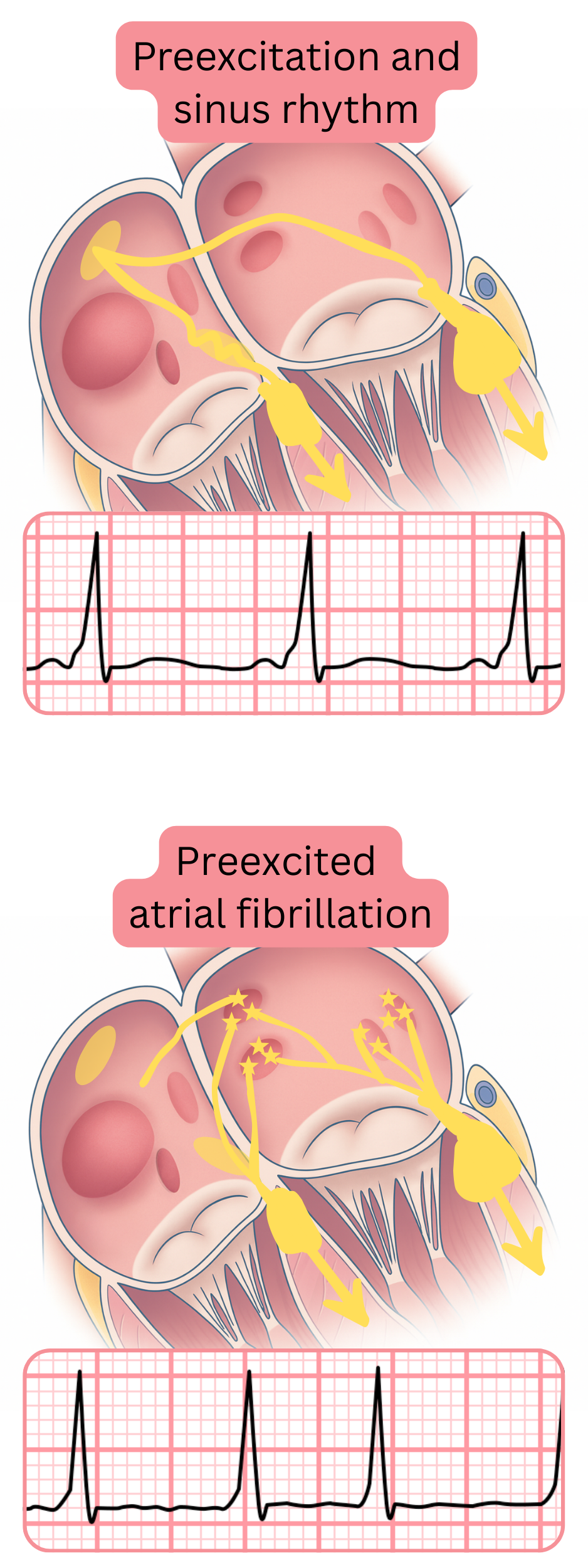
Comparison of preexcitation during sinus rhythm and preexcited atrial fibrillation on ECG.
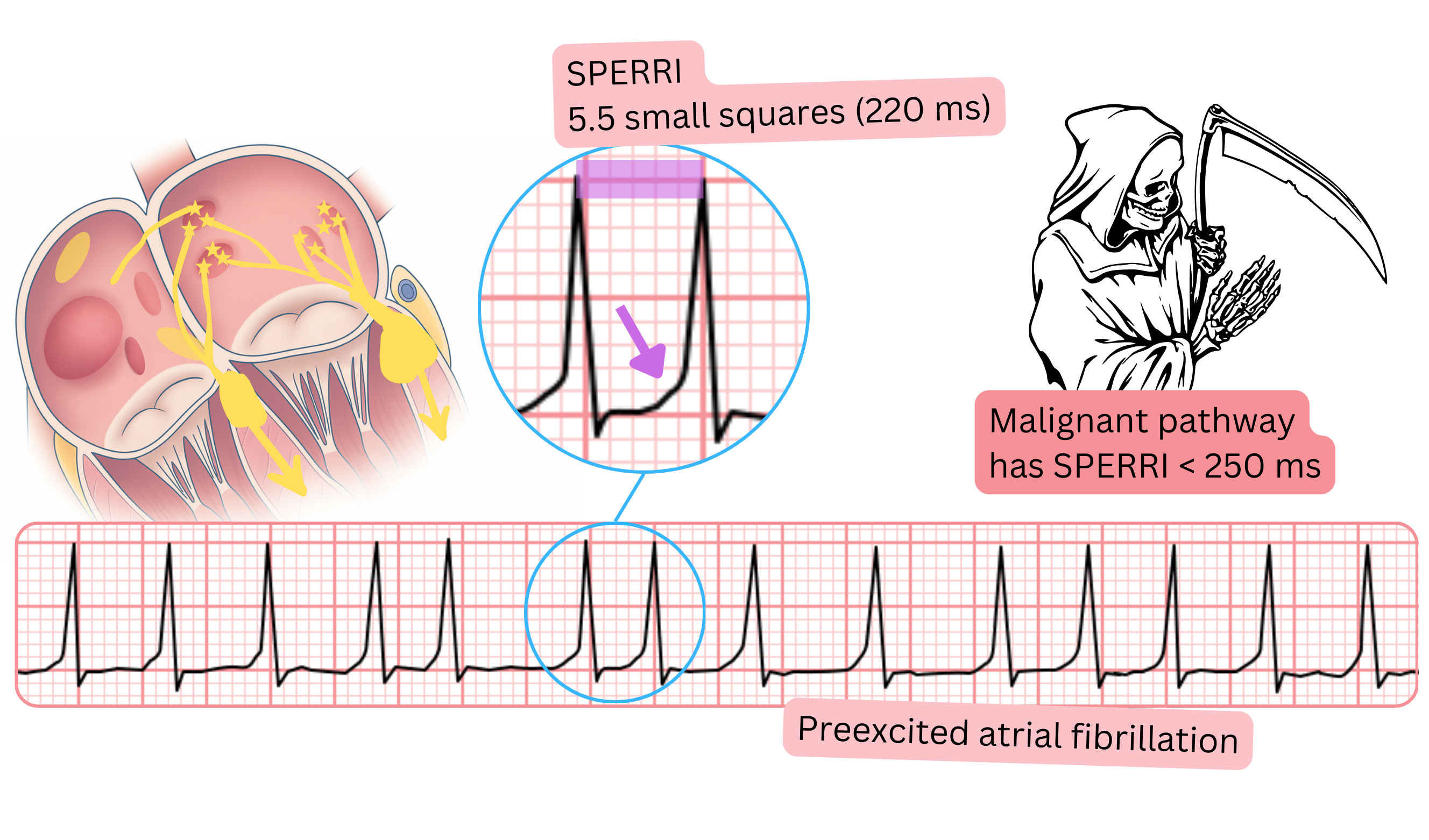
Preexcited atrial fibrillation with a short SPERRI below 250 ms on ECG.
Accessory pathway and atrial fibrillation Class
For treatment of WPW syndrome, catheter ablation of the accessory pathway is recommended. I
A malignant accessory pathway is defined as the shortest RR interval ≤250 ms with a delta wave (SPERRI ≤250 ms) during AF. I
For treatment of a malignant accessory pathway, catheter ablation of the accessory pathway is recommended. I
Ablation of the accessory pathway should be considered if SPERRI ≤300 ms. IIa
In pre-excited AF, the following are contraindicated:
  • Adenosine
  • Verapamil
  • Diltiazem
  • Beta-blockers
  • Digoxin
  • Amiodarone
III
In hemodynamically stable pre-excited AF, the following are recommended:
  • Procainamide
  • Ibutilide
  • Flecainide
I
In hemodynamically unstable pre-excited AF, electrical cardioversion is recommended. I
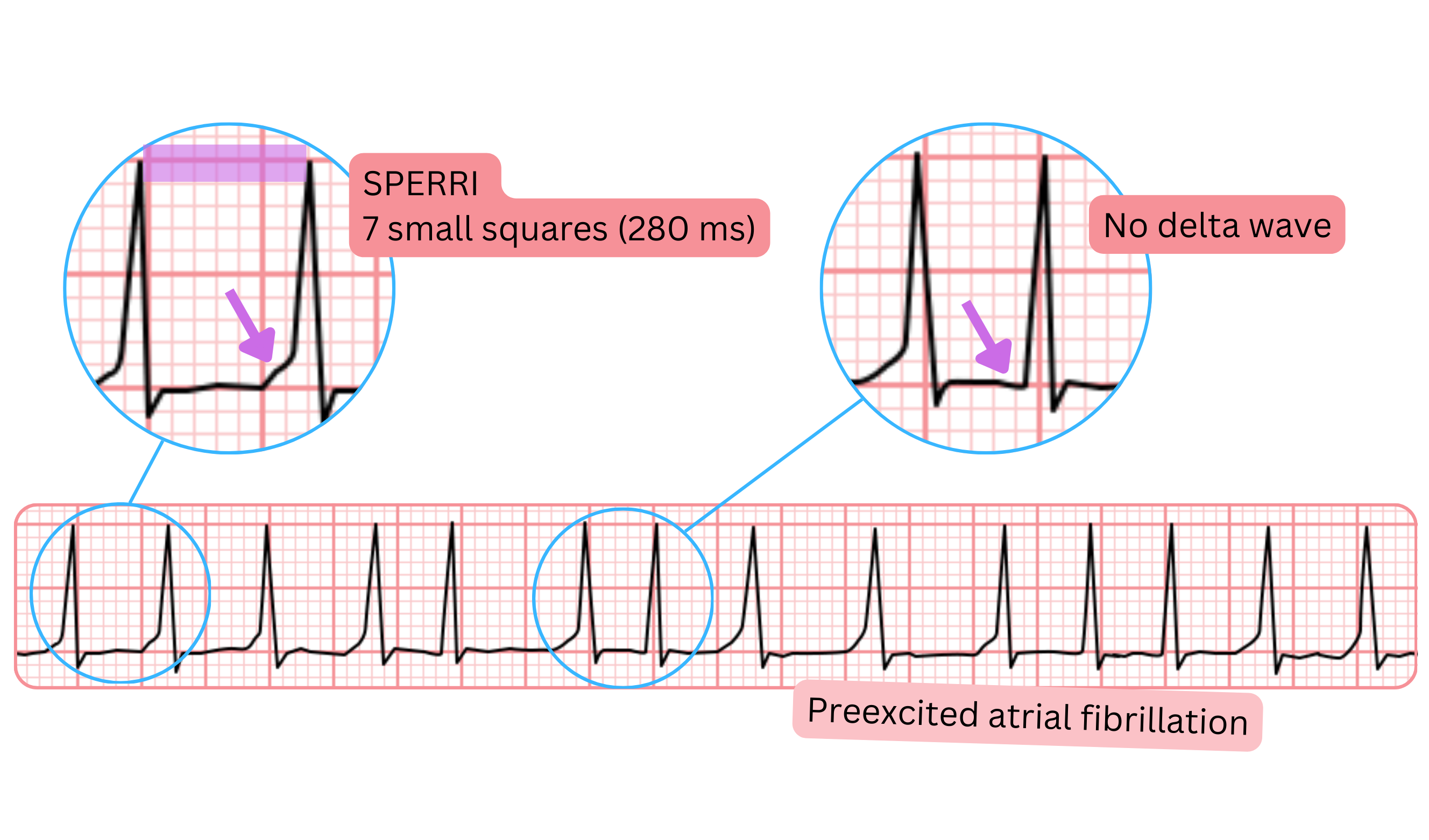
Preexcited atrial fibrillation with a longer SPERRI of 280 ms and absence of delta wave on ECG.

In pre-excited AF (AF + delta wave), all drugs that slow conduction through the AV node and do not block the accessory pathway are contraindicated. If the patient receives these drugs, ventricular fibrillation may occur. Contraindicated drugs include:

  • Adenosine
  • Verapamil
  • Diltiazem
  • Beta-blockers (metoprolol, bisoprolol, atenolol, esmolol, etc.)
  • Digoxin
  • Amiodarone
In pre-excited atrial fibrillation, the following may be administered
Procainamide
Ibutilide
Flecainide
Electrical cardioversion

These guidelines are unofficial and do not represent formal guidelines issued by any professional cardiology society. They are intended for educational and informational purposes only.

Peter Blahut, MD

Peter Blahut, MD (Twitter(X), LinkedIn, PubMed)