
In a patient with atrial fibrillation (AF) receiving anticoagulation therapy who has active bleeding,
For bleeding management, the following key information about anticoagulation therapy is essential:
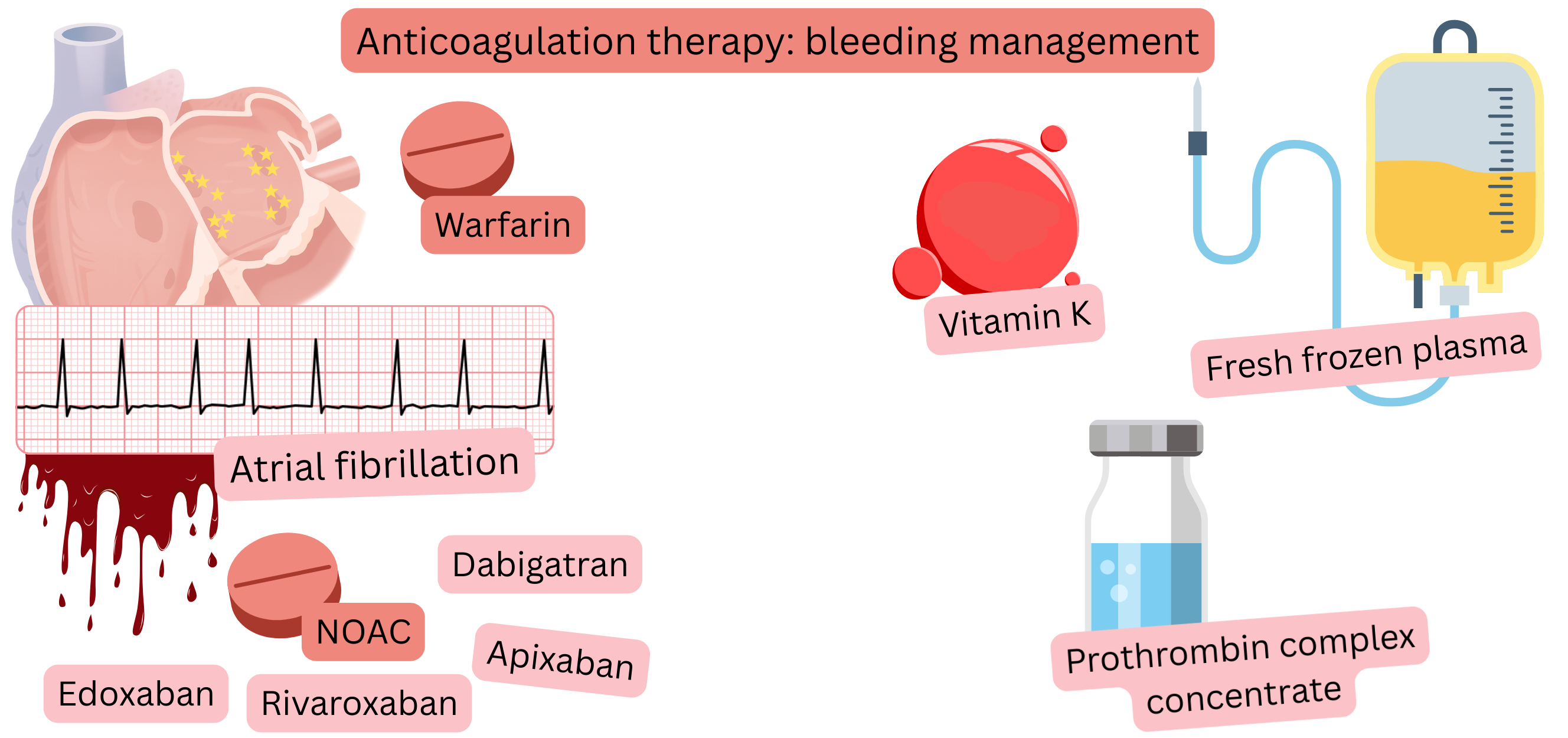
Vitamin K
Prothrombin complex concentrate
Fresh frozen plasma
Bleeding in a patient with AF receiving NOAC:
| Warfarin – Management of bleeding | ||
|---|---|---|
| Intervention | Onset of effect | Standard dose |
| Prothrombin complex concentrate | 10 – 30 min |
|
| Fresh frozen plasma | 4 – 6 hours |
|
| Vitamin K | 6 – 12 hours intravenous 24 hours oral |
|
Laboratory parameters that provide approximate information on the effect/overdose of anticoagulation therapy:
Routine monitoring of NOAC is not required.
| Anticoagulation therapy (onset, duration of effect, and antidote) | |||
|---|---|---|---|
| Drug | Onset of effect | Clinical effect after last dose | Antidote / reversal therapy |
| Warfarin | 3 – 5 days | 3 – 5 days | Vitamin K, PCC, FFP |
| Dabigatran | 1 – 3 hours | 24 – 36 hours | Idarucizumab |
| Apixaban | 2 – 4 hours | 24 hours | Andexanet alfa, PCC (off-label) |
| Rivaroxaban | 2 – 4 hours | 24 hours | Andexanet alfa, PCC (off-label) |
| Edoxaban | 1 – 2 hours | 24 hours | PCC (off-label) |
| LMWH | 2 – 4 hours | 12 – 24 hours | Partially neutralized by protamine |
LMWH – Low-Molecular-Weight Heparin (Enoxaparin, Dalteparin, Nadroparin). PCC – Prothrombin Complex Concentrate (Prothrombin complex concentrate). FFP – Fresh Frozen Plasma. Off-label means use of a drug outside an approved indication.
Antiplatelet therapy has a very short half-life but a very long clinical effect,
Antiplatelet drugs have a short plasma half-life, but their clinical effect lasts long.
| Antiplatelet therapy (elimination half-life and clinical effect) | ||
|---|---|---|
| Drug | Elimination half-life | Clinical effect after last dose |
| Aspirin | 20 min | 7 – 10 days |
| Clopidogrel | 6 hours | 7 – 10 days |
| Ticagrelor | 7 – 9 hours | 3 – 5 days |
| Prasugrel | 7 hours | 7 – 10 days |
Approximate annual risk of major bleeding in patients with HAS-BLED score < 2.
| Major bleeding risk with HAS-BLED < 2 | |
|---|---|
| Therapy | Major bleeding risk (per year) |
| Warfarin | 1.1 – 2.3 % |
| NOAC | 1.0 – 2.0 % |
| Aspirin | 0.5 – 1.5 % |
| Dual antiplatelet therapy (DAPT) | 1.5 – 2.5 % |
| No antithrombotic therapy | < 0.3 % |
| Management of bleeding and anticoagulation therapy | Class |
|---|---|
| In active bleeding (major or non-major), immediate interruption of anticoagulation therapy and investigation for the bleeding source is recommended. | I |
| In non-major bleeding (during warfarin therapy), discontinuation of warfarin and waiting for INR to fall below 2 and for bleeding to stop is recommended. | I |
| In non-major bleeding (during warfarin therapy), vitamin K (oral or intravenous) should be administered, and INR should be allowed to fall below 2. | IIa |
| In major bleeding (during warfarin therapy), prothrombin complex concentrate should be administered. | IIa |
| In non-major bleeding (during NOAC therapy), withholding NOAC for 1–2 days and waiting for bleeding to stop is recommended. | I |
| In non-major bleeding (during NOAC therapy), activated charcoal or gastric lavage should be administered (if the patient took NOAC within 4 hours). | IIa |
| In major bleeding (during NOAC therapy), an antidote or prothrombin complex concentrate should be administered. | IIa |
These guidelines are unofficial and do not represent formal guidelines issued by any professional cardiology society. They are intended for educational and informational purposes only.