Every patient with newly diagnosed atrial fibrillation (AF) must undergo a comprehensive evaluation in order to
One of the main pillars of AF management is the treatment of comorbidities and risk factors. Comprehensive AF management follows the SKC algorithm:
Newly diagnosed AF may occur spontaneously or as a consequence of a trigger. This trigger may also precipitate AF in the future. A trigger may be:
| Investigations in a Patient with Newly Diagnosed Atrial Fibrillation | Class |
|---|---|
|
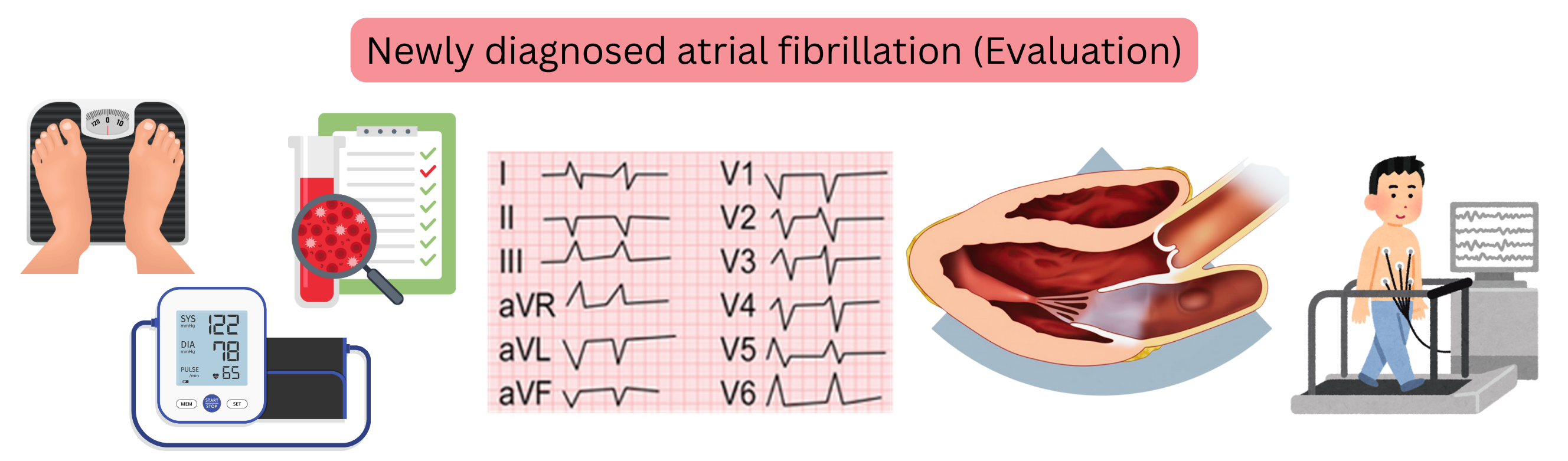
In every patient with newly diagnosed AF, the following investigations are recommended:
|
I |
A comprehensive evaluation in a patient with newly diagnosed AF is essential, as the patient’s symptoms may not be caused by AF. For example, a patient may have AF and dyspnoea, but the dyspnoea may be due to anaemia rather than AF.
Hemodynamically unstable newly diagnosed AF requires urgent treatment and often hospitalization.
The following table summarizes the basic investigations in a patient with newly diagnosed AF.
| Basic Investigations in Newly Diagnosed Atrial Fibrillation | |
|---|---|
| 12-lead ECG |
During AF, focusing on:
|
| Laboratory tests |
Laboratory tests focusing on:
|
| Transthoracic echocardiography (TTE) |
TTE focusing on:
|
| Exercise testing (stress ECG) |
Focusing on:
|
| CT coronary angiography |
Focusing on:
|
If there is a specific indication in AF, the following extended investigations are performed.
| Extended Investigations in Atrial Fibrillation | |
|---|---|
| Transoesophageal echocardiography (TEE) |
Focusing on:
|
| Selective coronary angiography |
Focusing on:
|
| Percutaneous coronary intervention (PCI) | In confirmed coronary artery disease indicated for PCI. |
| Cardiac MRI |
Focusing on:
|
| Brain CT (angiography) |
Focusing on:
|
| Brain MRI |
Focusing on:
|
These guidelines are unofficial and do not represent formal guidelines issued by any professional cardiology society. They are intended for educational and informational purposes only.