
ESUS (Embolic Stroke of Undetermined Source) is a cryptogenic embolic stroke.
The overall prevalence of ischemic stroke is 2–3% (> 7% in the population > 65 years).
According to CT or MR imaging, ischemic stroke can be classified as:
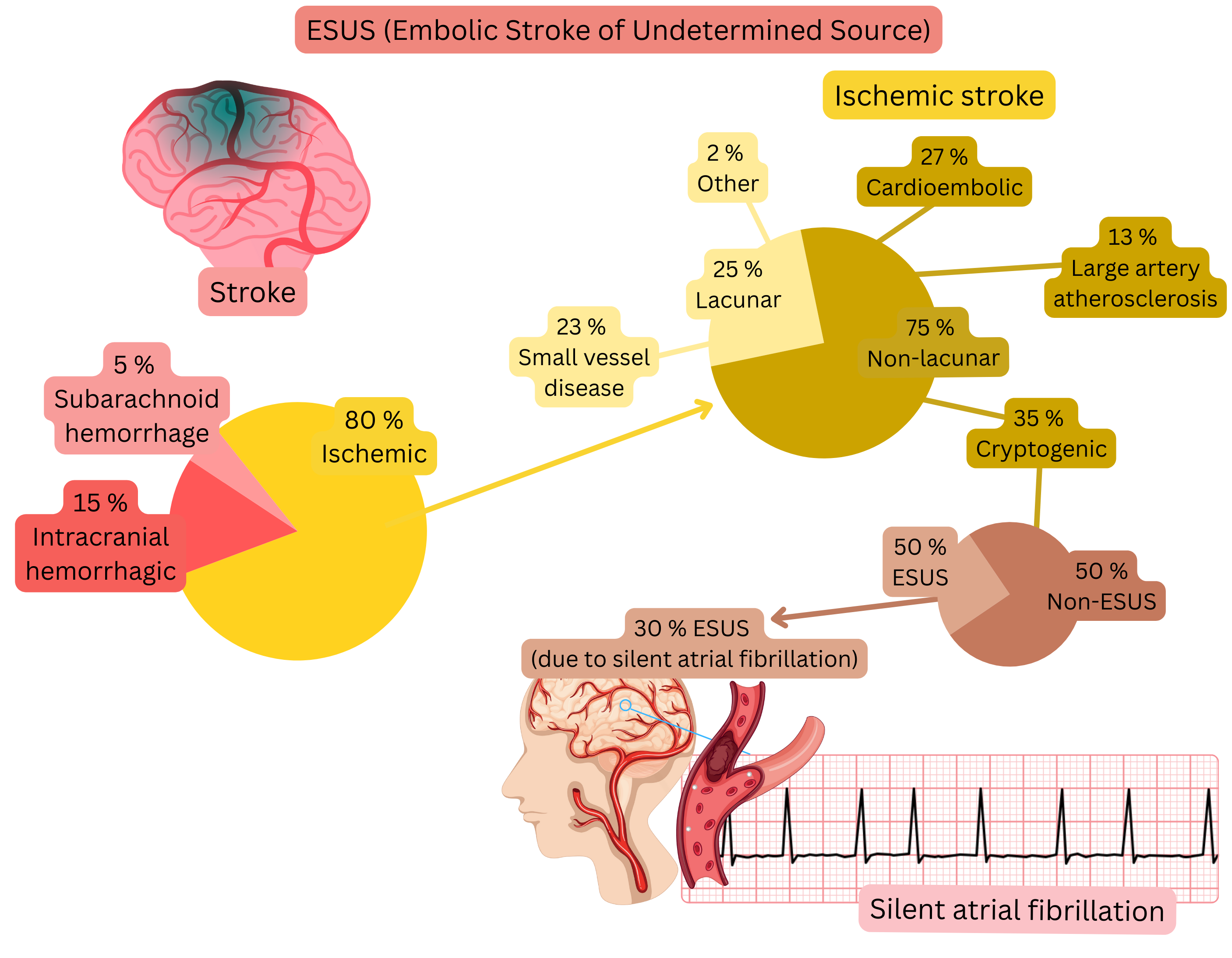
Cryptogenic stroke is a broad term referring to any ischemic stroke (embolic or non-embolic) without a diagnosed cause. Once a cause is identified, e.g. atrial fibrillation (AF), the cryptogenic stroke is reclassified as cardioembolic stroke in AF.
Cryptogenic stroke accounts for 35% of all ischemic strokes.
Cryptogenic stroke may be embolic or non-embolic. The term ESUS is used to designate cryptogenic embolic ischemic stroke.
ESUS (Embolic Stroke of Undetermined Source)
| ESUS (Embolic Stroke of Undetermined Source) – Causes |
|---|
| Atrial fibrillation (accounts for 30% of ESUS) |
| Atrial flutter |
| Intracardiac thrombi |
| Prosthetic valve (valve thrombosis) |
| Cardiac tumour |
| Mitral stenosis (moderate, severe) |
| Myocardial infarction (within the last 1 month) |
| Endocarditis |
ESUS accounts for
The annual risk of ESUS recurrence is 4.5%.
| Cryptogenic stroke vs. ESUS (Embolic Stroke of Undetermined Source) | ||
|---|---|---|
| Characteristic | Cryptogenic stroke | ESUS |
| Type of ischemic stroke | Lacunar, non-lacunar | Non-lacunar |
| Aetiology | Embolic, non-embolic | Embolic |
| Arterial stenosis (supplying the ischemic lesion) | Unspecified | < 50 % in the affected artery |
| Cardioembolic source | Possible | Highly probable (most commonly silent atrial fibrillation) |
| Practical use | General term for ischemic stroke of unclear cause | Rapid identification of patients with suspected silent atrial fibrillation |
Once AF is diagnosed in a patient with ESUS, ESUS is reclassified as cardioembolic stroke in AF.
| Screening for atrial fibrillation in patients after ESUS (Embolic Stroke of Undetermined Source) | Class |
|---|---|
| Implantation of a loop recorder is recommended. | I |
| During symptoms (specific or non-specific), immediate ECG recording using a smart device with ECG capability (ECG watch, blood pressure monitor with ECG, ECG card) is recommended. | I |
| ECG Holter monitoring may be considered: 24-hour or 7-day (preferably). | IIa |
| Anticoagulation therapy and ESUS (Embolic Stroke of Undetermined Source) | Class |
|---|---|
| Anticoagulation therapy is not recommended in patients after ESUS without documented AF. | III |
These guidelines are unofficial and do not represent formal guidelines issued by any professional cardiology society. They are intended for educational and informational purposes only.