
Haemodynamic instability in atrial fibrillation (AF):
Relative haemodynamic instability in AF:
Haemodynamic instability often occurs with tachy-AF with ventricular rate >150/min. Such a patient is tachypnoeic, dyspnoeic, and exhausted. Tachy-AF is most commonly triggered by:
Acute critical condition
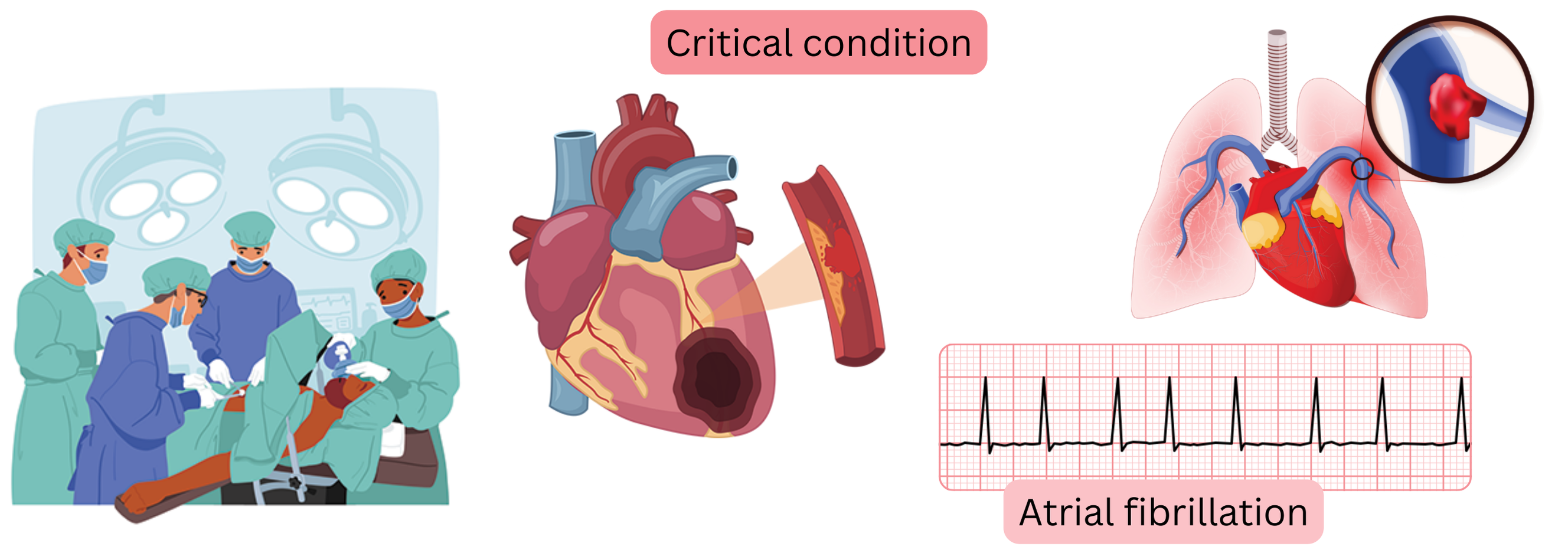
| Acute critical condition and incidence of atrial fibrillation (AF) | |
|---|---|
| Acute critical condition | Incidence of AF (%) |
| Cardiac surgery | 30 – 60 % |
| Acute heart failure | 25 – 50 % |
| Sepsis | 20 – 46 % |
| Acute respiratory distress syndrome (ARDS) | 20 – 40 % |
| Stroke | 10 – 30 % |
| Myocardial infarction (STEMI / NSTEMI) | 10 – 22 % |
| ICU patients | 5 – 25 % |
| Pulmonary embolism | 5 – 15 % |
| Major bleeding | 3 – 5 % |
Acute high-risk condition
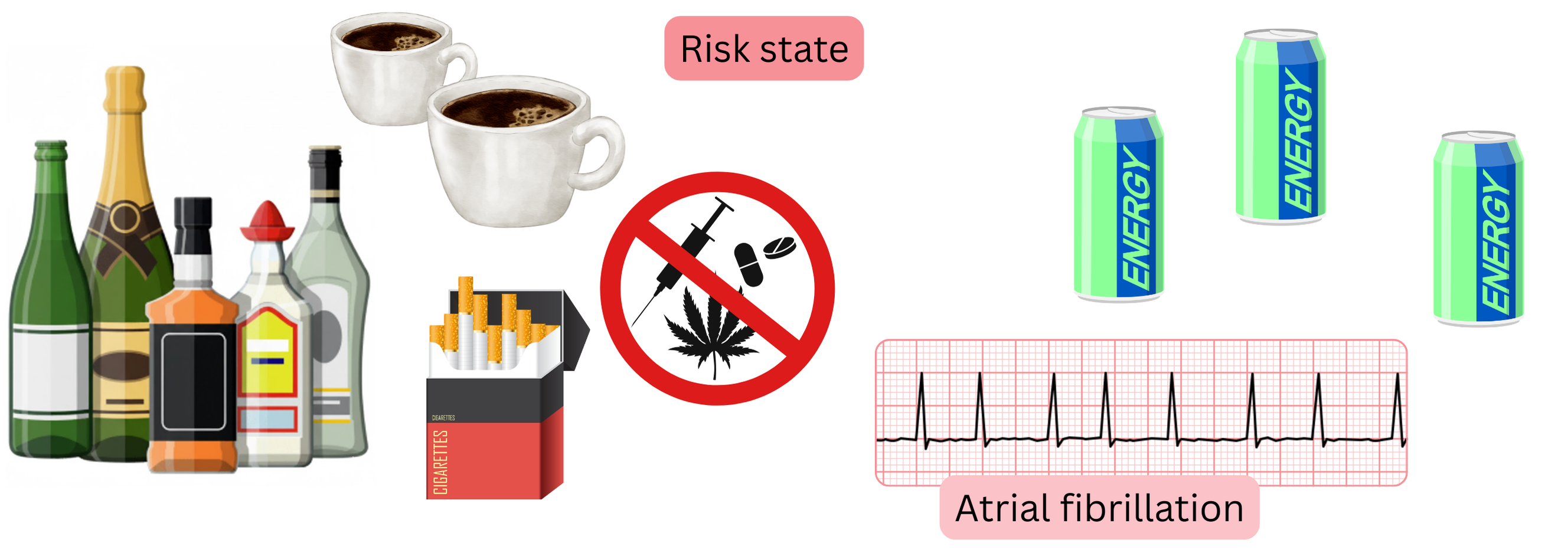
| Acute high-risk condition and incidence of atrial fibrillation (AF) | |
|---|---|
| Acute high-risk condition | Incidence of AF (%) |
| Alcohol excess | 20 – 30 % |
| Drug use (cocaine, methamphetamine, ecstasy) | 5 – 15 % |
| Extreme physical exertion | 2 – 4 % |
| Extreme stress | 2 – 4 % |
| Extreme sun exposure | 1 – 3 % |
| Coffee excess | 1 – 2 % |
| Energy drink excess | 1 – 2 % |
| Drug use (marijuana) | 1 – 2 % |
An acute critical or high-risk condition may trigger or worsen an AF episode. Based on history, 4 clinical situations are recognized:
| Acute conditions and atrial fibrillation | Class |
|---|---|
| Electrical cardioversion is recommended in a haemodynamically unstable patient with atrial fibrillation (AF). | I |
| Intravenous landiolol is recommended for acute rate control in a relatively haemodynamically unstable patient with AF. | I |
| Intravenous beta-blocker (esmolol, atenolol, metoprolol) may be considered for acute rate control in a relatively haemodynamically unstable patient with AF. | IIa |
After treatment and stabilization of the acute condition, AF spontaneously converts to sinus rhythm within 48 hours in up to 83 % of cases.
The following table summarizes key properties of beta-blockers,
| Beta-blockers (intravenous) – Acute treatment of atrial fibrillation (Rate control) | ||||||
|---|---|---|---|---|---|---|
| Beta-blocker (intravenous) | Dosing (intravenous) | Onset of effect | Duration of effect | β1/β2 selectivity | Effect on heart rate | Effect on blood pressure |
| Landiolol | Bolus 0.1 – 0.3 mg/kg, then infusion 1 – 40 µg/kg/min | 1 min | 15 min | 255 | ↓↓ | ≈ 0 |
| Esmolol | Bolus 0.5 mg/kg, then infusion 50 – 200 µg/kg/min | 2 min | 30 min | 33 | ↓ | ↓ |
| Atenolol | 5 – 10 mg intravenous slowly (5 min), may be repeated after 10 min | 5 min | 12 hours | 5 | ↓ | ↓ |
| Metoprolol | 2.5 – 5 mg intravenous every 2 – 5 min, max. 15 mg | 20 min | 5 – 8 hours | 2 | ↓ | ↓ |
The following table shows (intravenous) beta-blocker dosing for tachy-AF according to body weight (50 kg, 70 kg, 100 kg):
| Beta-blockers (intravenous) – Weight-based dosing | |||
|---|---|---|---|
| Beta-blocker (intravenous) | Patient (50 kg) | Patient (70 kg) | Patient (100 kg) |
| Landiolol | Bolus 5 – 15 mg Infusion 0.05 – 2 mg/min |
Bolus 7 – 21 mg Infusion 0.07 – 2.8 mg/min |
Bolus 10 – 30 mg Infusion 0.1 – 4 mg/min |
| Esmolol | Bolus 25 mg Infusion 2.5 – 10 mg/min |
Bolus 35 mg Infusion 3.5 – 14 mg/min |
Bolus 50 mg Infusion 5 – 20 mg/min |
| Atenolol | 5 – 10 mg (over 5 min) | 5 – 10 mg (over 5 min) | 5 – 10 mg (over 5 min) |
| Metoprolol | 2.5 – 5 mg (over 5 min) | 2.5 – 5 mg (over 5 min) | 2.5 – 5 mg (over 5 min) |
These guidelines are unofficial and do not represent formal guidelines issued by any professional cardiology society. They are intended for educational and informational purposes only.