
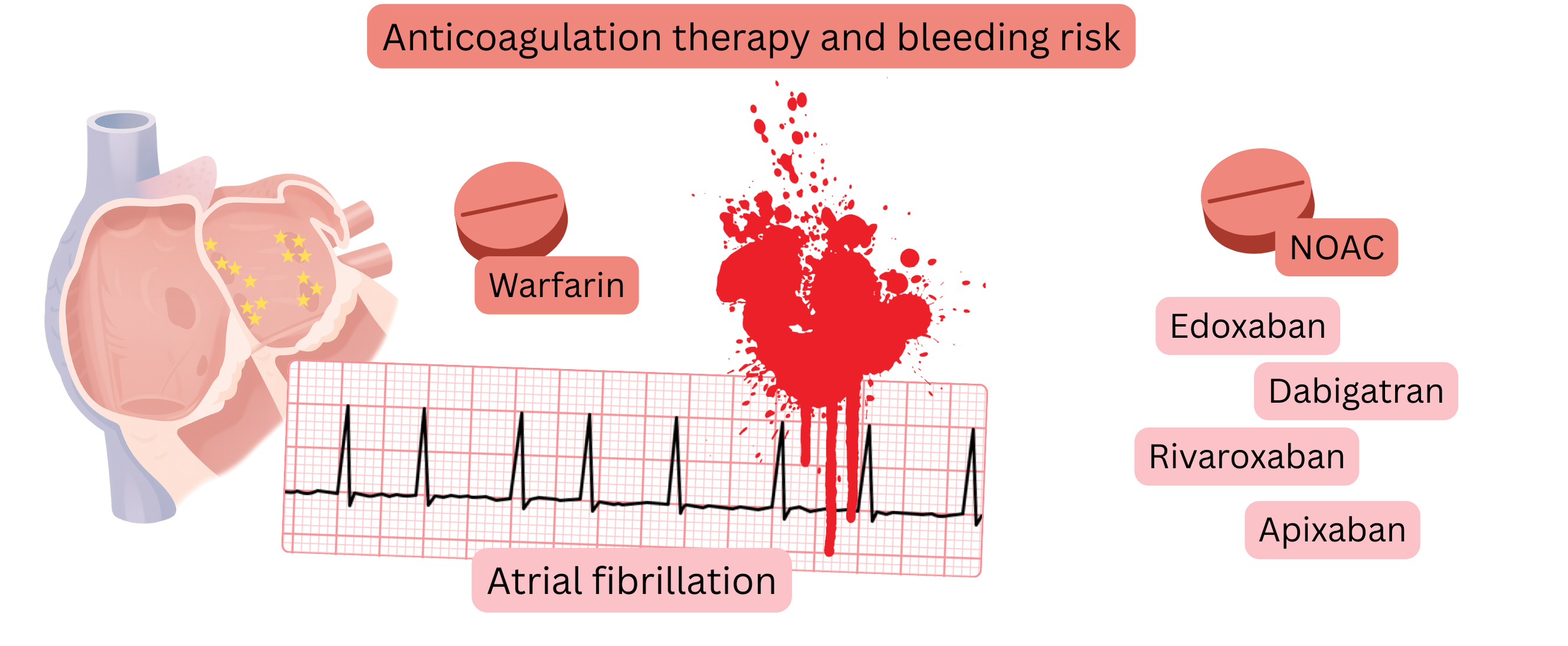
During anticoagulation therapy (NOAC or Warfarin) in patients with atrial fibrillation (AF), all modifiable risk factors should be corrected in order to reduce bleeding risk.
| Anticoagulation Therapy in Atrial Fibrillation and Modification of Risk Factors | |
|---|---|
| Modifiable risk factor | Target of modification |
| Uncontrolled hypertension (systolic blood pressure > 160 mmHg) | Systolic blood pressure < 140 mmHg |
| NSAIDs or antiplatelet therapy | Reduce or discontinue (if possible) |
| Excessive alcohol consumption (> 2 drinks daily) | Maximum 3 drinks per 7 days |
| Labile INR (during warfarin therapy) | Switch to NOAC (not in valvular AF) |
| Chronic kidney disease | NOAC dose adjustment |
| Chronic anaemia (haemoglobin < 110 g/l) | Investigate chronic blood loss |
| High risk of falls | Patient education |
| Poor adherence to pharmacotherapy | Patient education, pill organizers |
| Helicobacter pylori infection | Eradication therapy |
NOAC – Non-vitamin K Oral Anticoagulant (Dabigatran, Rivaroxaban, Apixaban, Edoxaban). NSAID - non-steroidal anti-inflammatory drugs (ibuprofen, diclofenac, naproxen, indomethacin, ketorolac)
Several scoring systems estimate the risk of major bleeding in patients with AF receiving anticoagulation therapy (warfarin or NOAC):
| HAS-BLED Score | ||
|---|---|---|
| Letter | Risk factor | Points |
| H |
Hypertension
|
1 |
| A |
Abnormal renal and/or liver function
|
1 or 2 |
| S |
Stroke
|
1 |
| B |
Bleeding
|
1 |
| L |
Labile INR
|
1 |
| E |
Elderly
|
1 |
| D |
Drugs and/or alcohol
|
1 or 2 |
NSAID - non-steroidal anti-inflammatory drugs (ibuprofen, diclofenac, naproxen, indomethacin, ketorolac)
The estimated annual risk of bleeding according to the HAS-BLED score is shown in the following table:
| HAS-BLED Score and Bleeding Risk | |
|---|---|
| Score | Annual bleeding risk |
| 0 | 1.13 % |
| 1 | 1.02 % |
| 2 | 1.88 % |
| 3 | 3.74 % |
| 4 | 8.7 % |
| 5 | 12.5 % |
| ≥6 | ≥12.5 % |
Modifiable risk factors and the HAS-BLED score serve as complementary clinical parameters.
Major bleeding in patients with AF receiving anticoagulation therapy includes:
| Major Bleeding During Anticoagulation Therapy |
|---|
| Gastrointestinal (melena, haematemesis, haemorrhage) |
| Genitourinary (haematuria) |
| Respiratory (haemoptysis) |
| Retroperitoneal |
| Pericardial |
| Intracranial |
| Intraspinal |
| Haemarthrosis (bleeding into joints) |
| Intraocular (retinal) |
Proton pump inhibitors (PPIs), e.g. pantoprazole, may be added to anticoagulation therapy as bleeding prevention if the patient has an increased risk of gastrointestinal bleeding:
| Increased Risk of Gastrointestinal Bleeding |
|---|
| History of gastrointestinal bleeding |
| Concomitant antiplatelet therapy |
| History of Helicobacter pylori infection |
| Concomitant NSAIDs, corticosteroids, SSRIs, certain antibiotics |
| Dyspepsia |
| Gastro-oesophageal reflux |
NSAID - Non-steroidal anti-inflammatory drugs (ibuprofen, diclofenac, naproxen, indomethacin, ketorolac). SSRI - Selective Serotonin Reuptake Inhibitors (fluoxetine, sertraline, citalopram, escitalopram, paroxetine, fluvoxamine)
Contraindications and relative contraindications to anticoagulation therapy are listed in the following tables:
| Anticoagulation Therapy – Contraindications | |
|---|---|
| Situation | Recommendation |
| Active or recent major bleeding | Anticoagulation contraindicated |
| Intracerebral / intraspinal bleeding | High risk of mortality or permanent sequelae |
| Peptic ulcer after bleeding (within 7 days) | High risk of recurrent bleeding |
| Large oesophageal varices | High risk of fatal bleeding |
| Platelets < 30 × 109/l | Anticoagulation contraindicated |
| Platelets 30 – 50 × 109/l | LMWH may be considered with caution |
| Pregnancy | NOAC and warfarin contraindicated; LMWH may be used |
| Liver cirrhosis with INR > 2 | Prefer LMWH; warfarin and NOAC are not recommended |
| Severe allergy to anticoagulants | Change the type of anticoagulation therapy |
NOAC – Non-vitamin K Oral Anticoagulant (Dabigatran, Rivaroxaban, Apixaban, Edoxaban). LMWH – Low-Molecular-Weight Heparin (Enoxaparin, Dalteparin, Nadroparin)
| Anticoagulation Therapy – Relative Contraindications | |
|---|---|
| Situation | Note |
| Coagulopathy or vasculitis | Higher bleeding risk |
| Thrombocytopenia 50 – 80 × 109/l | Individual assessment required |
| Anaemia (< 100 g/l) | Of unclear origin |
| History of intracranial bleeding | Possible benefit of anticoagulation in high thrombotic risk |
| Intracranial or spinal tumour | Higher bleeding risk |
| Gastrointestinal bleeding (within the last 6 months) | Uncertain bleeding source |
| Peptic ulcer (7 – 14 days after bleeding) | With adequate treatment |
| Dementia or cognitive impairment | Risk of incorrect medication use |
| Severe hypertension (> 180/100 mmHg) | Blood pressure stabilization required |
| Chronic kidney disease | NOAC or LMWH dose adjustment |
| Liver cirrhosis with INR > 1.5 | Increased bleeding risk |
| Tumour with vascular invasion | High bleeding risk |
NOAC – Non-vitamin K Oral Anticoagulant (Dabigatran, Rivaroxaban, Apixaban, Edoxaban). LMWH – Low-Molecular-Weight Heparin (Enoxaparin, Dalteparin, Nadroparin)
| Bleeding Risk and Anticoagulation Therapy | Class |
|---|---|
| During anticoagulation therapy, adequate control of modifiable factors that increase bleeding risk is recommended. | I |
| Anticoagulation therapy should not be discontinued based on bleeding risk scores (e.g. HAS-BLED). Bleeding scores serve only to estimate bleeding risk. | III |
| PPIs (proton pump inhibitors) may be added to anticoagulation therapy in patients at higher risk of gastrointestinal bleeding. | IIa |
These guidelines are unofficial and do not represent formal guidelines issued by any professional cardiology society. They are intended for educational and informational purposes only.