Time in Therapeutic Range (TTR) and Warfarin
Warfarin therapy is considered adequate:
- if the patient maintains an INR of 2–3 for at least 70 % of the observed period.
- For example, if a patient takes warfarin for 100 days, INR 2–3 must be maintained for at least 70 days (70 %).
- In clinical practice, it is unrealistic to measure INR daily over 100 days.
- The parameter that provides this information is referred to as TTR (Time in Therapeutic Range),
- which represents the time spent within the therapeutic range.
TTR indicates what percentage of a given period (e.g. 100 days) the patient maintains an INR of 2–3. TTR must be calculated by a physician.
- TTR 70 % means that if a patient takes warfarin for 100 days, INR was 2–3 for 70 days and outside 2–3 for the remaining 30 days.
However, INR cannot be measured daily. To calculate TTR, the so-called Rosendaal method is used,
- which assumes that INR rises and falls gradually and linearly over time.
- For example, a physician measures INR twice with a 10-day interval:
- Day 1 – INR 2.5
- Day 10 – INR 1.5
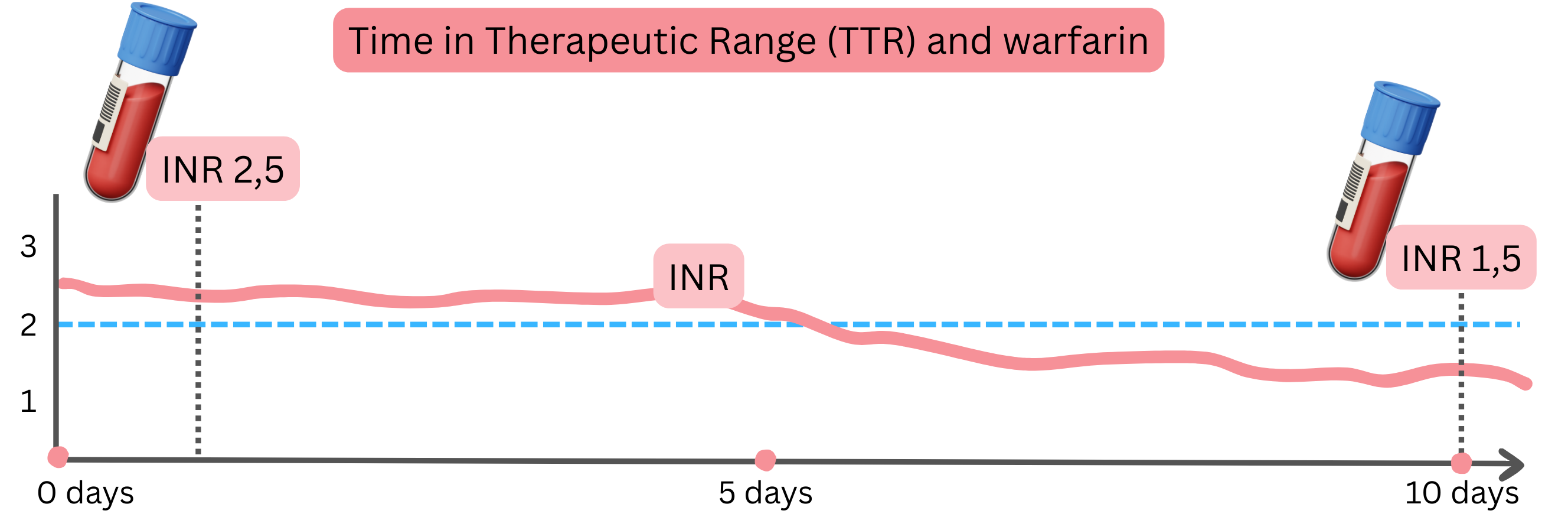
The Rosendaal method assumes a linear decrease in INR over 10 days (2.5 → 1.5).
- Using the formula, it calculates that INR dropped below 2 on Day 5.
- Therefore, the patient had INR 2–3 for 5 days and below 2 for 5 days. TTR for these 10 days is 50 %.
In practice, due to the technical and mathematical complexity, TTR is used only rarely.
- In routine practice, “TTR” is often assessed by giving equal weight to each INR value.
- If a patient has 10 INR measurements and 4 are outside the therapeutic range, TTR is 60 %.
| Time in Therapeutic Range (TTR) and Atrial Fibrillation |
Class |
| In clinical practice, TTR (Time in Therapeutic Range) during warfarin therapy may be assessed using the Rosendaal method. |
IIb |