Electrophysiology CINRE, hospital BORY
Atrial Fibrillation: Guidelines (2026) Compendium / 13.3 Pharmacological (oral) cardioversion of atrial fibrillation – Pill in the Pocket

Pharmacological (oral) cardioversion of atrial fibrillation – Pill in the Pocket


The Pill in the Pocket strategy is acute termination of a paroxysmal atrial fibrillation (AF) episode in the home setting.

  • The patient carries a “pill in the pocket” and takes it when a symptomatic AF episode occurs.
  • Symptoms are tolerated and a medical visit is not required.
Diagram of pharmacological cardioversion of atrial fibrillation using oral antiarrhythmic drugs, highlighting the need to exclude left atrial thrombus before restoration of sinus rhythm.

In the Pill in the Pocket strategy, Class IC antiarrhythmic drugs (propafenone, flecainide) are administered,

  • for safety monitoring,
  • the first dose of a Class IC antiarrhythmic drug should always be administered during hospital admission; the most serious adverse effects include:
    • Ventricular arrhythmia
    • AV block (I, II, III degree)
    • 1:1 conducted atrial flutter
    • Hypotension (systolic <90 mmHg)
    • Bradycardia (<50/min)

The Pill in the Pocket strategy is intended for patients without frequent episodes of paroxysmal AF and

  • who do not agree with chronic pharmacological therapy or do not tolerate it,
  • and who also refuse AF ablation.

Indications (Pill in the Pocket):

  • Paroxysmal AF with episodes occurring approximately once every 2–6 months.
  • Inability to use chronic therapy (due to adverse effects or patient refusal)
    • Refusal of AF ablation.

The patient receives chronic anticoagulation according to the CHA2DS2-VA score.

Diagram of class IC antiarrhythmic drugs (flecainide, propafenone) illustrating the risk of conversion of atrial fibrillation into unblocked atrial flutter with 1:1 conduction in the absence of AV nodal blockade.

Class IC antiarrhythmic drugs and 1:1 conducted atrial flutter

  • Class IC antiarrhythmic drugs (flecainide, propafenone) slow conduction in the atrial myocardium.
  • In AF, chaotic activity may slow and organize into a regular re-entry circuit.
  • The result is atrial flutter (often with a lower atrial rate of ~200/min).
    • The AV node may conduct this “slower” flutter with 1:1 conduction.
    • This results in 1:1 conducted atrial flutter with a ventricular rate of ~200/min.
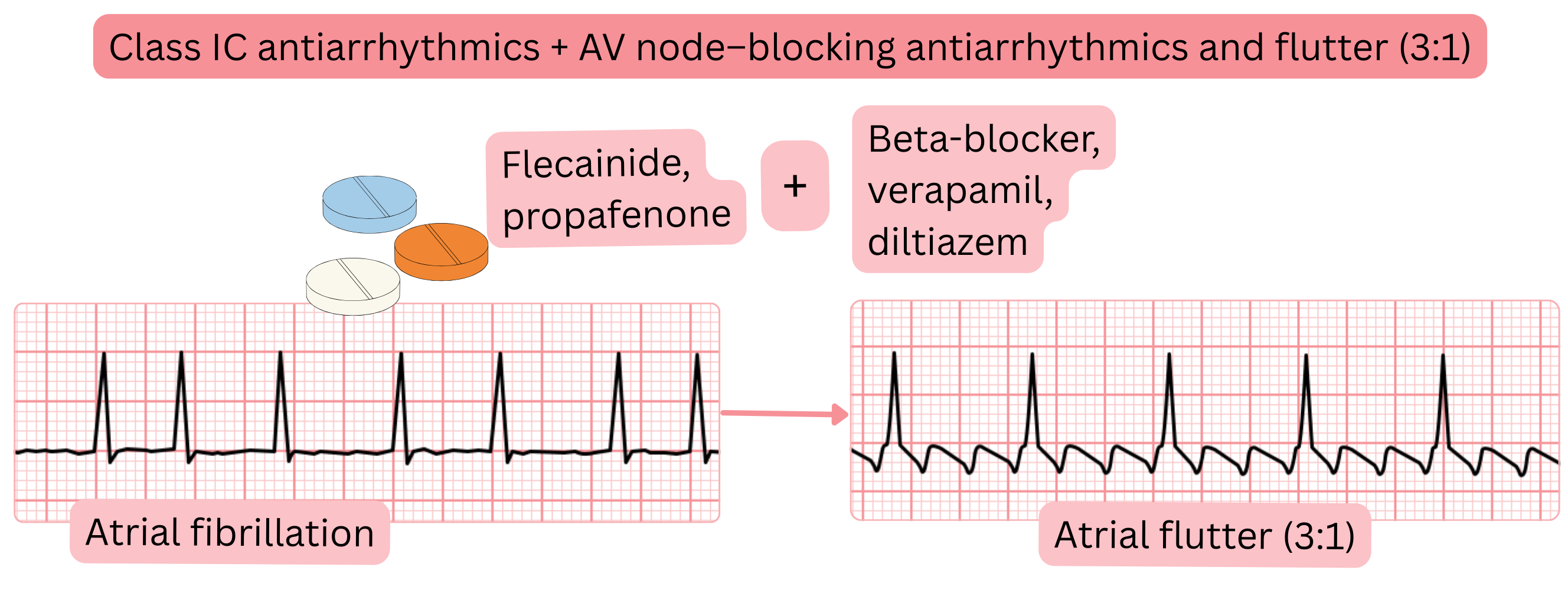
  • To prevent 1:1 conducted atrial flutter, Class IC antiarrhythmic drugs are administered together with drugs that slow AV nodal conduction:
    • Beta-blockers
    • Verapamil
    • Diltiazem
  • The risk of 1:1 conducted atrial flutter with Class IC antiarrhythmic drugs is:
    • 2–6% – if no concomitant AV nodal–slowing therapy is administered.
Prevention of 1:1 conducted atrial flutter before oral Class IC administration (propafenone, flecainide)
Drug Route Dose Timing before Class IC administration
Metoprolol oral 25 mg 30 min before Class IC administration
Verapamil oral 80 mg 30 min before Class IC administration
Diltiazem oral 60 mg 30 min before Class IC administration
Diagram illustrating combination therapy with class IC antiarrhythmic drugs and atrioventricular nodal blocking agents showing conversion of atrial fibrillation to atrial flutter with controlled 3:1 conduction.

Pill in the Pocket treatment strategy:

  • If the patient develops an AF episode and it does not terminate within 10 minutes, for prevention of 1:1 conducted atrial flutter,
  • the patient takes (oral) one AV nodal–blocking drug:
    • Diltiazem 60 mg
    • Verapamil 80 mg
    • Metoprolol tartrate 25 mg
  • After 30 minutes, the patient takes (oral) a single dose of a Class IC antiarrhythmic drug for AF cardioversion:
    • Flecainide (may also be used during pregnancy)
      • 300 mg (>70 kg)
      • 200 mg (<70 kg)
    • Propafenone
      • 600 mg (>70 kg)
      • 450 mg (<70 kg)
Pill in the Pocket – Class IC antiarrhythmic drugs
Drug Route Patient weight Dose
Flecainide
(may be administered during pregnancy)
oral > 70 kg 300 mg
Flecainide
(may be administered during pregnancy)
oral < 70 kg 200 mg
Propafenone oral > 70 kg 600 mg
Propafenone oral < 70 kg 450 mg

The patient may take the above single dose of a Class IC antiarrhythmic drug only once within 24 hours.

  • If the AF episode persists, the Class IC dose must not be repeated.

If cardioversion does not occur within 6 hours after taking the Class IC antiarrhythmic drug, the patient should seek medical attention.

Class IC antiarrhythmic drugs (oral) – time to conversion and success rate
Antiarrhythmic drug Class Time to conversion Success rate Typical patient
Flecainide (oral) IC 3–8 h 50–85 % Patient without structural heart disease.
Propafenone (oral) IC 3–8 h 45–78 % Patient without structural heart disease.

Pharmacological (oral) cardioversion of atrial fibrillation Class
The “Pill in the Pocket” strategy (use of propafenone or flecainide at home) may be considered in patients with paroxysmal, oligosymptomatic atrial fibrillation with episodes occurring approximately once every 2–6 months. IIa
In the “Pill in the Pocket” strategy (propafenone or flecainide), concomitant AV nodal–blocking therapy (beta-blocker, verapamil, diltiazem) should be used to prevent 1:1 conducted atrial flutter. IIa

These guidelines are unofficial and do not represent formal guidelines issued by any professional cardiology society. They are intended for educational and informational purposes only.

Peter Blahut, MD

Peter Blahut, MD (Twitter(X), LinkedIn, PubMed)