Electrophysiology CINRE, hospital BORY
Atrial Fibrillation: Guidelines (2026) Compendium / 11.2 Antiarrhythmic Drugs and Atrial Fibrillation – Classification and Effects

Antiarrhythmic Drugs and Atrial Fibrillation – Classification and Effects


According to the Vaughan Williams classification, antiarrhythmic drugs are divided into four main classes (I–IV).

Antiarrhythmic drugs are classified according to which receptors in the heart they act on:

  • receptors of ion channels involved in the action potential
  • receptors of the autonomic nervous system

Digoxin is an antiarrhythmic drug, but it does not act directly on receptors in the heart.

  • Digoxin increases vagal tone, which subsequently inhibits the action potential predominantly in the AV node
  • and additionally reduces ventricular myocardial contractility
Vaughan Williams classification – antiarrhythmic drugs in atrial fibrillation (AF)
Class Mechanism ECG effect Antiarrhythmic drug Main use in AF Note
I A Na⁺ blockade + mild K⁺ blockade ↑ QT,
± ↑ QRS
Procainamide Cardioversion (acute intravenous) Risk of TdP with prolonged QT
Disopyramide Rhythm control (rarely) Anticholinergic adverse effects (urinary retention, glaucoma)
I C Strong Na⁺ blockade ↑ QRS Flecainide Cardioversion, rhythm control Only in the absence of structural heart disease (CAST trial)
Propafenone Cardioversion, rhythm control Only in the absence of structural heart disease (CAST trial)
II β-receptor blockade ↑ PR,
↓ rate
Beta-blockers Rate control First choice in AF + hypertension/ischaemic heart disease
III K⁺ channel blockade (some also Na⁺, Ca²⁺, β-blockade) ↑ QT,
± ↑ QRS/PR
Amiodarone Cardioversion, rhythm control Most effective, but many adverse effects with long-term use
Sotalol Rhythm control Requires QTc monitoring, risk of TdP
Dronedarone Rhythm control (less effective) A “weak amiodarone”
Ibutilide Cardioversion (intravenous) Acute cardioversion of pre-excited AF and atrial flutter, risk of TdP
IV Ca²⁺ channel blockade (non-DHP) ↑ PR,
↓ rate
Verapamil Rate control Contraindicated if EF < 40 %
Diltiazem Rate control Preferred in hypertension and AF
V Various mechanisms Various effects Digoxin Rate control Effective at rest, less during exertion. Preferred if EF < 40 %
Vernakalant Cardioversion (intravenous) Atrial-selective, few adverse effects

TdP – Torsades de Pointes, AFl – atrial flutter, IHD – ischaemic heart disease
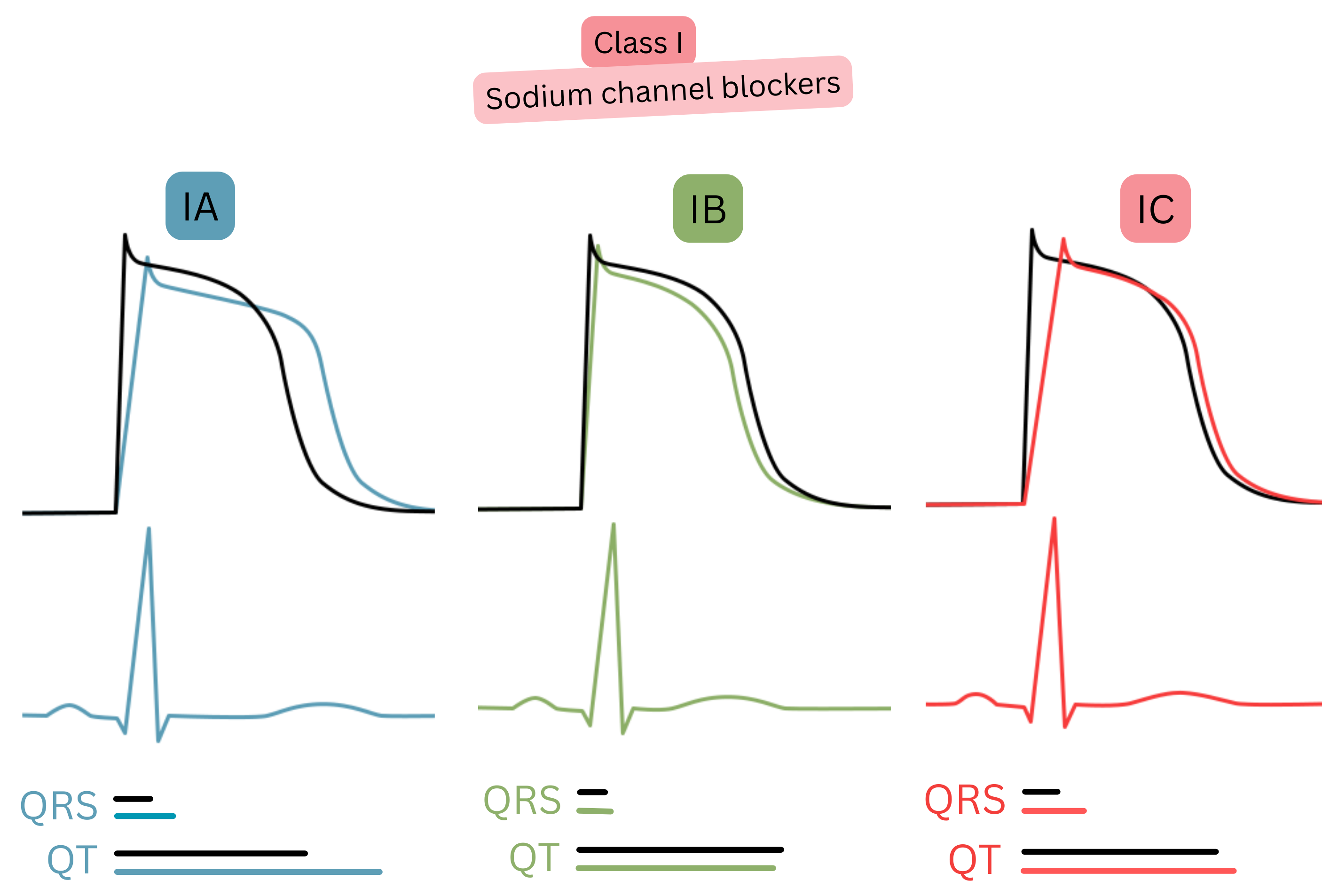
Diagram of the effects of class I antiarrhythmic drugs illustrating differences between subclasses IA, IB, and IC in their impact on the action potential, QRS complex width, and QT interval on ECG.

Class I (Na⁺ channel blockers)

  • They block the non-nodal action potential (AP), mainly Na⁺ channels, in the ventricular myocardium:
    • Activated Na⁺ channels during phase 0, or
    • Inactivated Na⁺ channels during phases 1, 2, 3
  • According to how strongly and which Na⁺ channels they block, they are divided into 3 groups:
    • Class IA
    • Class IB
    • Class IC
  • Intensity of Na⁺ channel blockade in phase 0: IC > IA > IB
    • which is seen on the ECG as QRS widening and PR interval prolongation
    • the wider the QRS and PR, the slower the conduction velocity of the AP through the ventricles and atria,
      • therefore, the atrial fibrillation (AF) rate slows.
    • Class IC widens QRS and slows conduction the most: IC
  • Intensity of Na⁺ channel blockade in phases 1, 2, 3: IA > IC > IB
    • which is seen on the ECG as QT interval widening
    • the wider the QT, the longer the effective refractory period (ERP).
    • The atrial myocardium remains non-excitable for longer, which prevents rapid re-propagation of impulses and re-entry.
      • They lower the threshold of the maximum AF rate
  • They are use-dependent (their effect increases at rates > 90/min),
    • because at rates > 90/min diastole (phase 4) shortens and Class I antiarrhythmic drugs remain bound to Na⁺ channels for longer
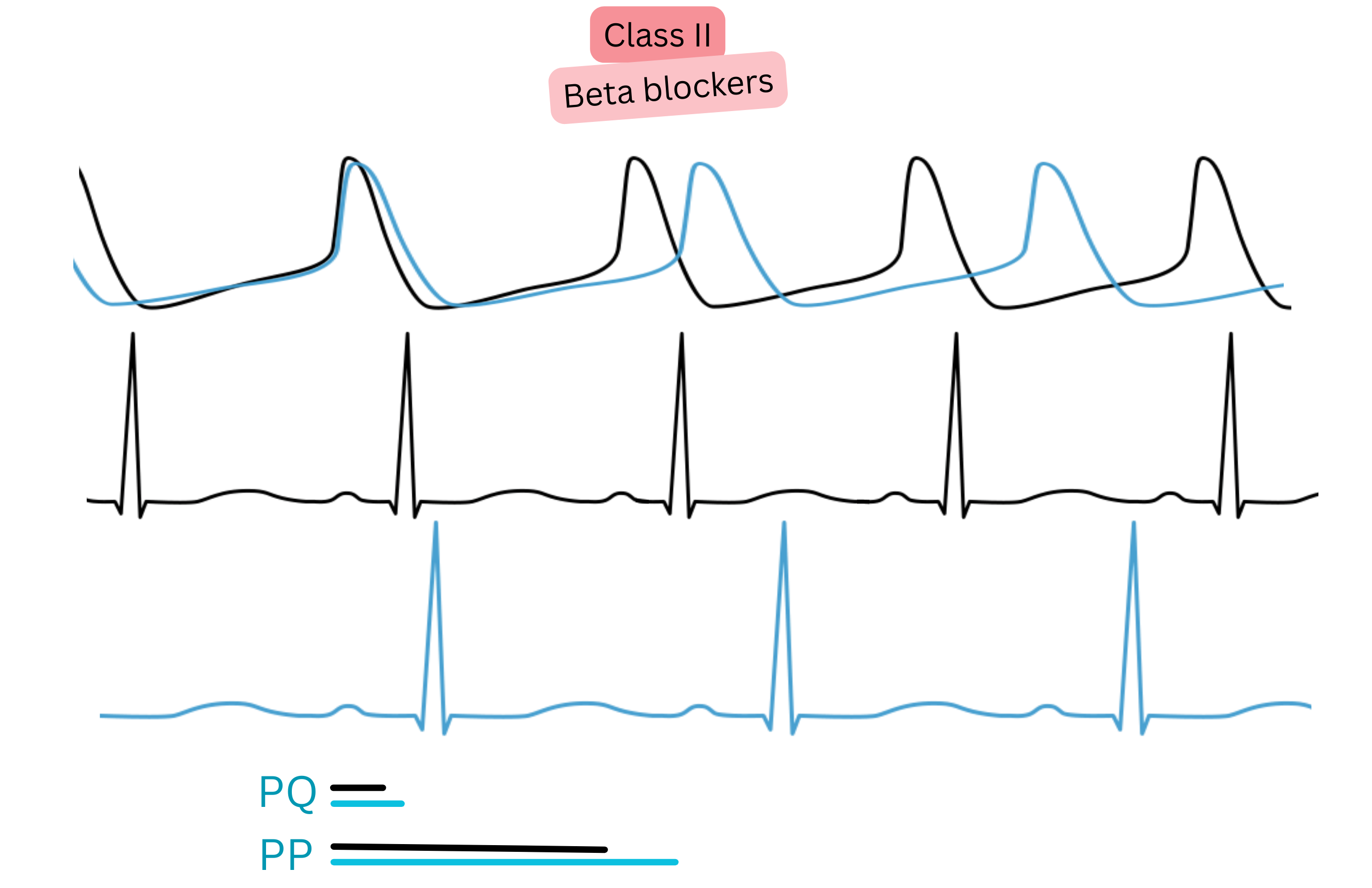
Diagram of the effect of class II antiarrhythmic drugs—beta-blockers—illustrating suppression of sympathetic activity with slowing of sinus rhythm and prolongation of the PP and PQ intervals on ECG.

Class II (Beta-blockers)

  • They block the nodal action potential (AP), beta receptors, in the SA and AV nodes.
  • They bind to β-adrenergic receptors and block catecholamines.
  • According to which β receptors they block, beta-blockers (BB) are divided into:
    • Non-selective BB – block β1 and β2
    • Selective BB – predominantly block β1 (and less β2)
  • β1 receptors are located predominantly in the SA node and then in the AV node
  • They act predominantly on β1 receptors in the SA node and prolong phase 4 of the AP.
    • they slow the SA node rate during sinus rhythm (negative chronotropic effect)
  • BB have a greater effect when the patient has increased sympathetic tone:
    • more during the day than at night, high-stress occupations
  • They slow conduction through the AV node and prolong the effective refractory period (ERP) of the AV node; the effect in AF is:
    • they slow the ventricular rate during AF because they slow the AV node (negative dromotropic effect).
    • they lower the threshold of the maximum ventricular rate during tachy-AF.
  • They reduce ventricular contractility (negative inotropic effect)
  • Via β2 receptors, they may cause bronchospasm, which is the main adverse effect
    • therefore, β1-selective BB are used in AF
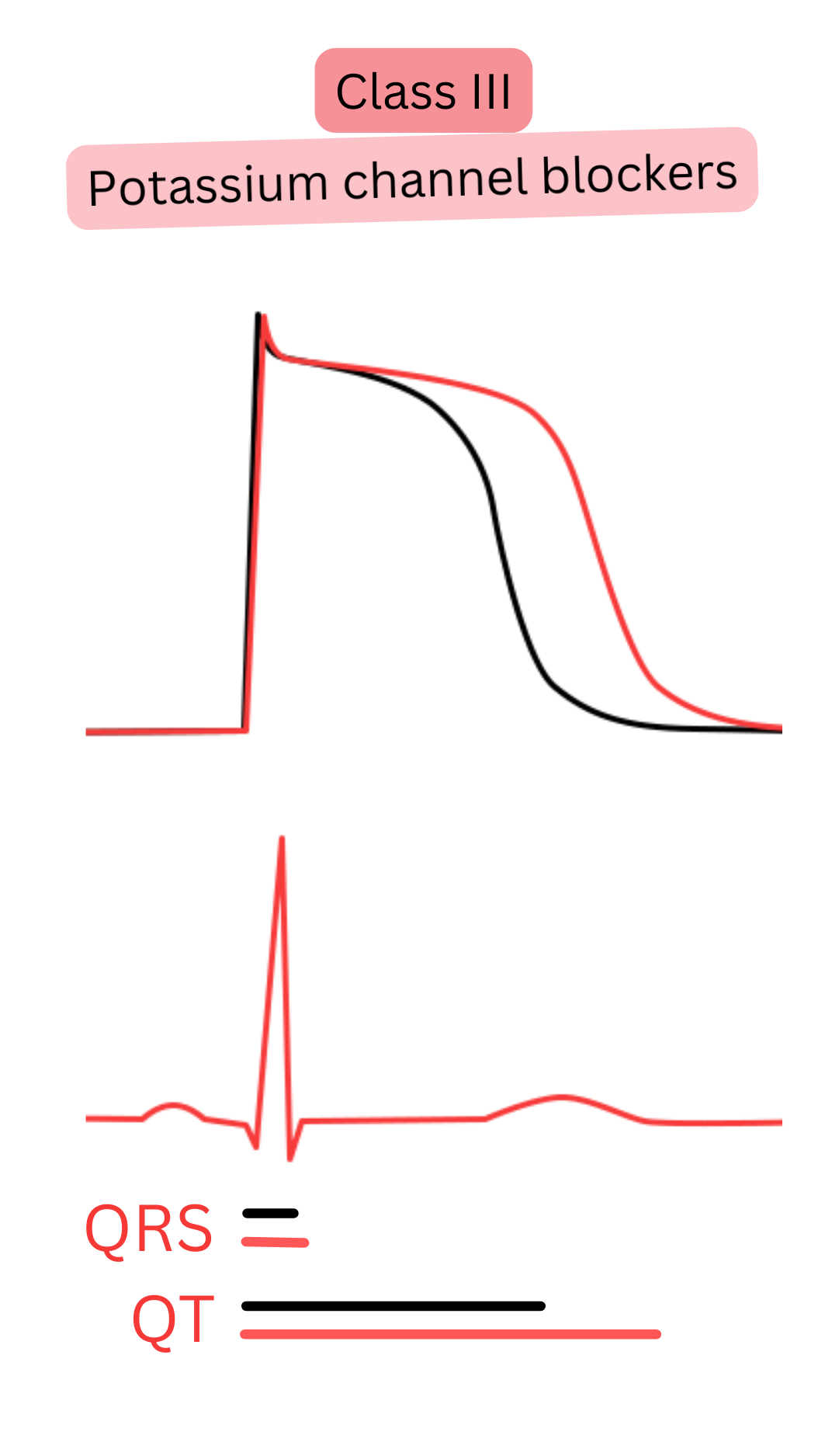
Diagram of the effect of class III antiarrhythmic drugs—potassium channel blockers—illustrating prolongation of action potential repolarization and the QT interval on ECG with unchanged QRS complex duration.

Class III (K⁺ channel blockers)

  • They block the non-nodal action potential (AP), mainly K⁺ channels, in the ventricular myocardium.
  • They predominantly block K⁺ channels during repolarization in phase 3 of the AP.
  • They prolong the effective refractory period (ERP), which is seen on the ECG as QT interval prolongation
    • The atrial myocardium remains non-excitable for longer, which prevents rapid re-propagation of impulses and re-entry.
    • They lower the threshold of the maximum AF rate
  • Amiodarone
    • is an antiarrhythmic drug with a “mixed” mechanism of action
      • it predominantly blocks K⁺ channels and also partially blocks other action potential channels (K⁺, Na⁺, Ca²⁺) as well as β receptors.
    • it is classified as a Class III antiarrhythmic drug because it predominantly blocks K⁺ channels
    • it is among the most effective antiarrhythmic drugs because it blocks all AP channels and β receptors.
      • however, it has the most adverse effects, which often necessitate discontinuation
      • and it should not be used for longer than 12 months.
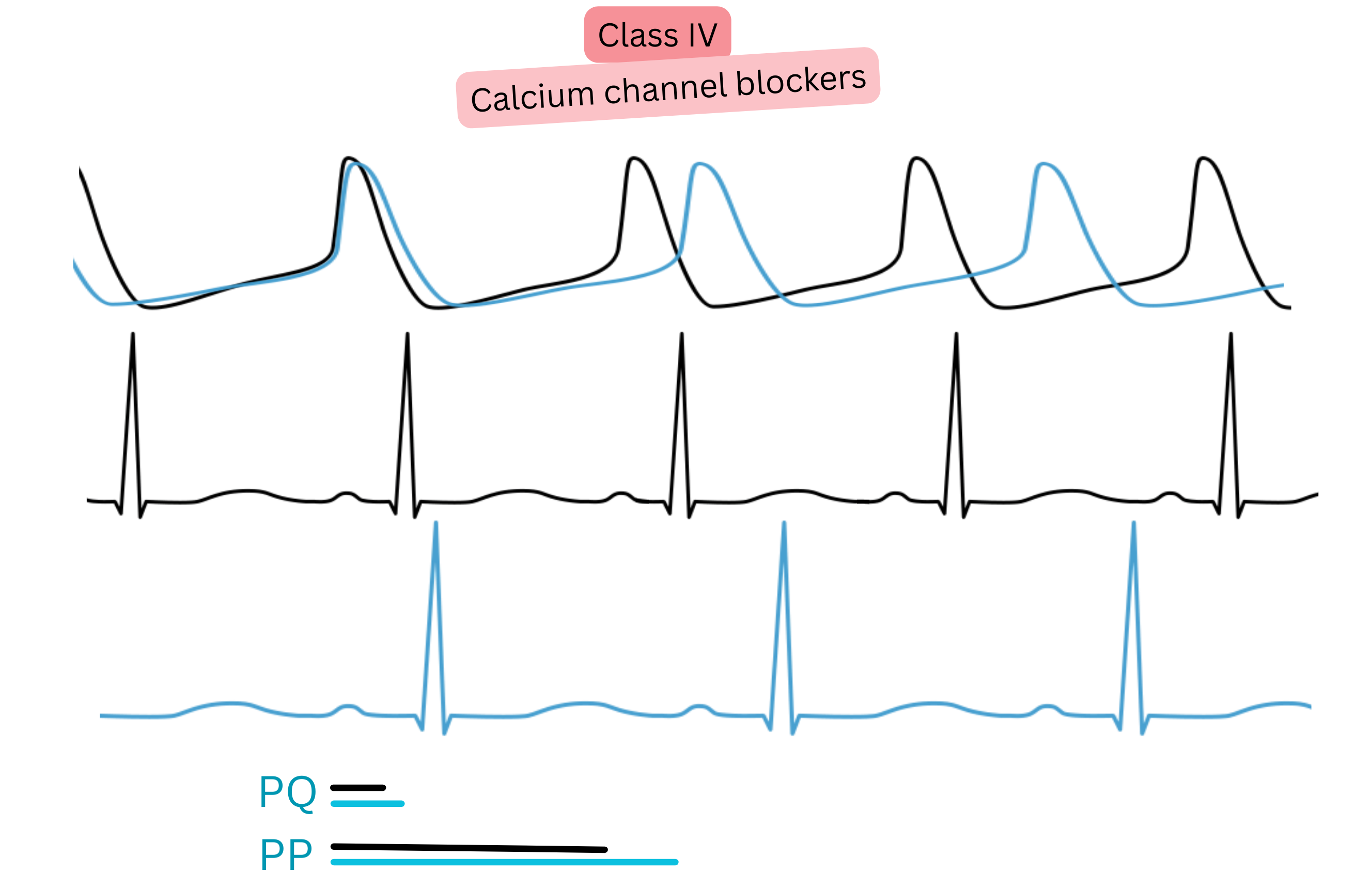
Diagram of the effect of class IV antiarrhythmic drugs—calcium channel blockers—illustrating slowed atrioventricular conduction with prolongation of the PQ interval and reduction of heart rate on ECG.

Class IV (Ca²⁺ channel blockers)

  • They are highly selective blockers of the nodal action potential (AP), Ca²⁺ channels, in the AV and SA nodes.
  • They predominantly block the AV node and then the SA node
  • They prolong AV nodal conduction and the effective refractory period (ERP) of the AV node:
    • they slow the ventricular rate during atrial fibrillation (AF)
    • they lower the threshold of the maximum ventricular rate during tachy-AF.
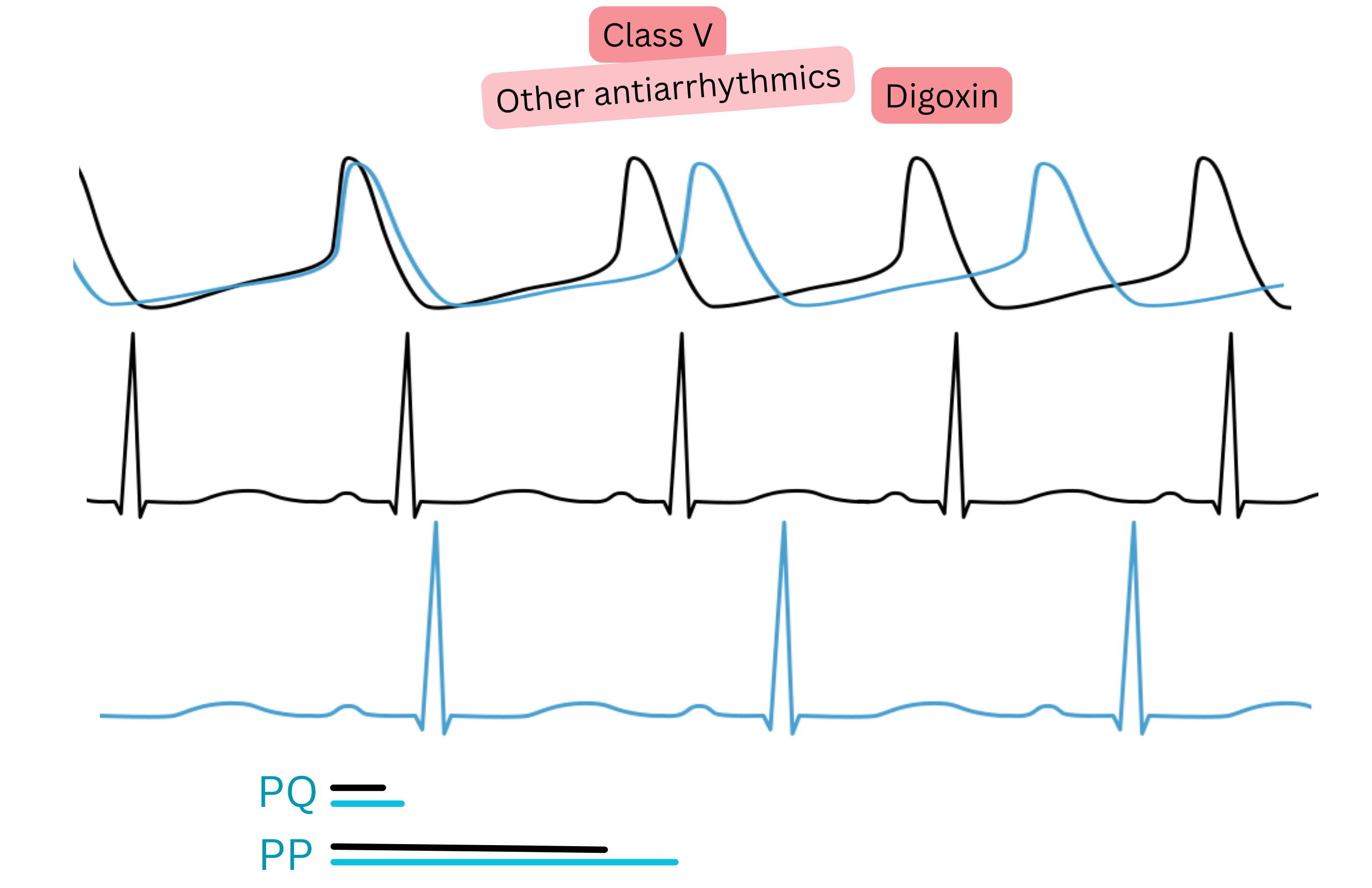
Diagram of the effect of digoxin as a class V antiarrhythmic illustrating increased parasympathetic activity with prolongation of the PQ interval and slowing of heart rate on ECG.

Digoxin

  • It stimulates the vagus nerve and inhibits the nodal action potential (AP) in the AV node and SA node.
  • Digoxin acts:
    • predominantly on the AV node, and subsequently
    • on the SA node and ventricular myocardium
  • Digoxin is formally not included in any of the four main Vaughan Williams antiarrhythmic classes (I–IV)
    • however, in practice it is often referred to as an “other antiarrhythmic drug” or a “Class V antiarrhythmic drug” (although this is not an official category).
  • It increases ventricular contractility (positive inotropic effect)
    • it inhibits the Na⁺/K⁺ pump, which leads to an increase in intracellular Ca²⁺,
    • resulting in positive inotropy and an increased left ventricular ejection fraction.
Antiarrhythmic treatment – Main contraindications Class
Antiarrhythmic treatment is not recommended in patients:
  • with sick sinus syndrome (without a pacemaker). Do not administer:
    • Beta-blockers
    • Sotalol
    • Amiodarone, Dronedarone
    • Flecainide, Propafenone
  • with second- or third-degree AV block (without a pacemaker). Do not administer:
    • Beta-blockers
    • Sotalol
    • Amiodarone, Dronedarone
    • Flecainide, Propafenone
    • Verapamil, Diltiazem
  • with QTc interval >500 ms. Do not administer:
    • Amiodarone, Dronedarone
    • Sotalol
    • Ibutilide
    • Procainamide, Disopyramide
    • Flecainide, Propafenone
III

These guidelines are unofficial and do not represent formal guidelines issued by any professional cardiology society. They are intended for educational and informational purposes only.

Peter Blahut, MD

Peter Blahut, MD (Twitter(X), LinkedIn, PubMed)