
The 2026 Compendium of Guidelines for atrial fibrillation (AF) contains numerous recommendations.
Each recommendation represents a specific diagnostic test, procedure, or treatment. A recommendation (diagnostic test, procedure, treatment) provides a certain benefit to the patient.
The degree of benefit of each recommendation is interpreted using a simple grading system that assigns a class to each recommendation.
The grading system of the 2026 Compendium of Guidelines for AF, similar to the European European Society of Cardiology guidelines, uses four classes. The higher the class, the greater the benefit of the recommendation (diagnostic approach, procedure, or treatment) for the patient.
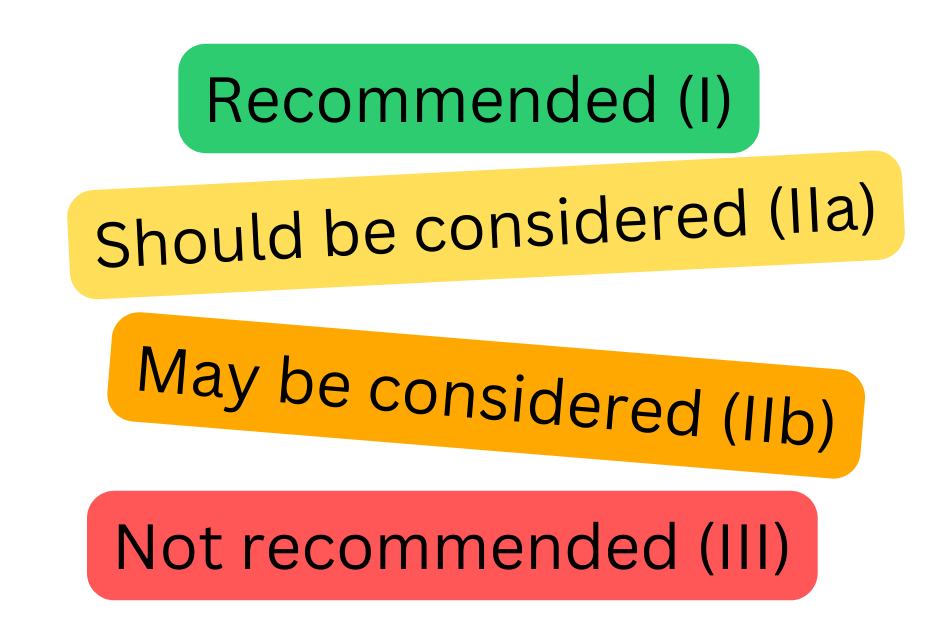
The grading system assigns one class to each recommendation. The class assigned to each recommendation is based on data from publications, clinical trials, and consensus of cardiologists.
In a given patient, the recommendation (diagnostic test, procedure, treatment) with the greatest benefit for the patient, i.e. the “strongest class”, should always be applied.
The 2026 Compendium of Guidelines for AF uses four classes that allow physicians to quickly and easily determine which recommendation provides the greatest benefit for the patient.
| Class | Interpretation | Explanation | Benefit for the patient |
|---|---|---|---|
| I | Is recommended | Evidence shows that the diagnostic test, procedure, or treatment is beneficial, useful, and effective. It is strongly recommended. | ≥90% benefit |
| IIa | Should be considered | Evidence shows that the diagnostic test, procedure, or treatment is beneficial, useful, and effective, but to a lesser extent than Class I. | 75–89% benefit |
| IIb | May be considered | Evidence shows that the diagnostic test, procedure, or treatment has a weak but certain benefit for the patient. | 50–74% benefit |
| III | Is not recommended | Evidence suggests that the diagnostic test, procedure, or treatment is not useful or may cause harm to the patient. | <50% benefit, may cause harm to the patient |
These guidelines are unofficial and do not represent formal guidelines issued by any professional cardiology society. They are intended for educational and informational purposes only.